Business Process Outsourcing Services
Healthcare & Medical Groups
Patient balance resolution, pre-service financial counseling, HIPAA-aligned communications

Business Process Outsourcing Services
Recovering outstanding payments is only half the challenge. The other half is doing it without losing the customer. Redial BPO’s debt collection services combine compliance, professionalism, and empathetic communication to manage outstanding balances through reminder calls, payment plans, and debt negotiation, while protecting the relationships your business depends on.
Our international debt collection service operates in full alignment with regulatory guidelines and data privacy laws across every region we serve.
Real-time reporting keeps you informed of recovery rates, payment statuses, and campaign outcomes at every stage, so you always have a clear picture of where your accounts stand.
Outsourcing to Redial BPO as your professional debt collection service provider reduces operational costs, maximizes cash flow, and preserves consumer goodwill, all through a respectful and results-driven process that reflects your brand values, not just your bottom line.

Proven collection strategies to recover more while maintaining customer goodwill.
Our processes align with international debt collection regulations and data privacy laws.
We utilize empathy-driven communication to maintain our brand reputation and foster cooperation.
Collections handled across time zones in English and Spanish by agents in Mexico, South Africa, and the Philippines.
Strategies tailored to your industry, customer profile, and aging accounts.
Outsourcing debt collections is one of the highest-leverage decisions an business can make — but only when you have the right information. Explore our complete library of guides, compliance resources, and industry-specific playbooks.
The Complete Guide to Outsourcing Debt Collection for SMBs
Learn when to outsource, how to evaluate a partner, what it costs, and how to make the transition without disrupting your operations.
Read the Guide →
FDCPA, TCPA & Regulation F: The SMB Compliance Guide
The legal landscape for collections has never been more complex. Understand your exposure under federal law — and how a compliant BPO partner eliminates your risk.
Explore Compliance →
AI-Powered Debt Recovery: How Technology Is Changing Collections
Large enterprises have deployed AI in 80% of AR departments. SMBs can now access the same capability through the right outsourcing partner. Here’s what that means for your recovery rates.
Explore AI in Collections →
Outsourced Collections for Every Industry
Healthcare, property management, utilities, SaaS, fintech, and B2B each face distinct recovery challenges. Find the playbook built for your sector.
Find Your Industry →
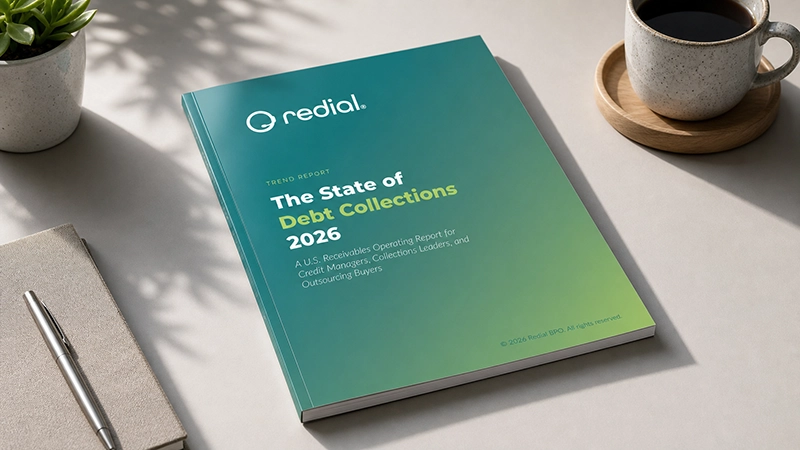
The Collections Crisis: How SMBs Can Recover More Revenue Without the Compliance Risk
Our 2026 industry trend report identifies the three forces making in-house collections untenable — and outlines the practical path forward for SMB leaders.
Download the Free Report →
What is outsourced debt collection?
Outsourced debt collection is when a business engages a third-party service provider — like Redial BPO — to contact customers with past-due balances on their behalf and recover outstanding payments. The outsourced partner handles the full collection workflow: skip tracing, outbound contact, payment negotiation, payment plan setup, and documentation. Businesses outsource collections to reduce operational costs, access dedicated compliance infrastructure, increase recovery rates, and free their internal teams from a function that requires specialized expertise. Redial operates in both first-party (white-label, as your brand) and third-party (as a named collection agency) models depending on the engagement.
What is the difference between first-party and third-party collections?
First-party collections occur early in the delinquency cycle — typically within the first 90–180 days — when the original creditor still owns the debt and the collector contacts the customer as a representative of that business. The experience feels like an extension of the brand’s customer service team. Third-party collections occur when the debt is later in the cycle, often past 180 days, and is assigned or sold to a collection agency that operates under its own identity. Redial supports both models. First-party programs are typically white-labeled under your brand name and are governed by your customer relationship standards. Third-party programs operate under FDCPA third-party collector rules, which impose additional requirements around disclosures and dispute handling.
Is Redial BPO FDCPA compliant?
Yes. FDCPA compliance is built into every collections program Redial operates. This includes proper mini-Miranda disclosures on every first contact, strict call frequency controls that respect the 7-in-7 rule under Regulation F, Do Not Call list scrubbing, call recording and documentation, agent training on prohibited communication practices, and a structured dispute and cease-communication handling process. Compliance is not a checkbox — it is a continuous operational requirement, and Redial treats it as such.
What regulations govern debt collection in the United States?
U.S. debt collection is governed by several overlapping federal and state laws. The primary federal frameworks are: the Fair Debt Collection Practices Act (FDCPA), which governs third-party collectors’ communication practices and prohibits harassment, false representations, and unfair practices; Regulation F, the CFPB’s implementing rule for the FDCPA, which introduced the 7-in-7 call frequency cap, electronic communication rules, and the Model Validation Notice; the Telephone Consumer Protection Act (TCPA), which governs how and when collectors may contact consumers by phone and text; and CFPB supervisory authority, which enforces compliance for both first- and third-party collectors at scale. State-level laws (New York, California, Texas, and others) often impose additional requirements. Redial’s compliance program is built to the most current interpretation of all applicable federal rules, with state-specific overlays as required.
What is Regulation F and how does it affect collections?
Regulation F is the CFPB’s final rule implementing the FDCPA, which took effect November 30, 2021. It introduced four major changes to collections practice. First, it established a 7-in-7 call frequency limit — collectors may not place more than seven calls to a consumer about a specific debt within any seven-day period, and must wait seven days after a connected conversation before calling again. Second, it created the Model Validation Notice, a standardized format for the initial communication that informs consumers of their rights. Third, it clarified the rules around electronic communications — email and text are permissible under defined conditions, including opt-out mechanisms and prior consent. Fourth, it introduced Limited-Content Messages, a voicemail format that does not trigger the full FDCPA disclosure requirements. Complying with Regulation F requires procedural systems that most in-house collections teams do not have — which is one of the primary operational reasons SMBs outsource to specialists like Redial.
How does Redial handle TCPA compliance in collections?
TCPA compliance in collections is one of the highest-risk areas in the industry — a single class action can exceed $15 million in statutory damages. Redial’s TCPA compliance program covers: prior express written consent documentation for contacts made via autodialer or prerecorded voice; manual dial protocols for consumers where consent is unclear; real-time revocation handling within 10 business days (compliant with current FCC guidance); scrubbing against the National Do Not Call Registry and internal DNC lists; and ongoing agent training on prohibited contact methods. Every contact type and channel is mapped to the consent basis that authorizes it, and that documentation is maintained throughout the account lifecycle.
What recovery rates can I expect from outsourced debt collection?
A standard Redial collections engagement follows this structure:
Does Redial BPO offer bilingual debt collection?
Yes. Bilingual English and Spanish collections is a core Redial capability — not an add-on. Our nearshore delivery centers in Tijuana and Mexicali provide large pools of fully bilingual agents trained in collections-specific communication in both languages. This is a material advantage: Spanish-speaking consumers contacted in their native language engage more readily, explain their situation more fully, and resolve accounts at measurably higher rates than when contacted in English only. For any portfolio with Hispanic demographic concentration — which describes most major U.S. markets — bilingual capability is not optional, it is a recovery rate driver.
How does Redial protect consumer data in collections?
Data security in collections is non-negotiable. Redial’s security program includes: PCI DSS certification for all payment processing interactions; encrypted transmission of all account data between client systems and Redial’s delivery platforms; role-based access controls that limit agent data access to only the fields required for their function; physical security at all delivery centers including badge access, clean desk policies, and no-device zones in operations areas; and contractual data handling protections established in the client services agreement. For healthcare-adjacent collections involving PHI, HIPAA BAAs are executed as part of the client onboarding process.
How much does outsourced debt collection cost?
Collections pricing typically follows one of three models. Contingency pricing (the most common) charges a percentage of amounts successfully recovered — typically 15–35% depending on account age, debt type, and volume, with older and smaller balance accounts priced at the higher end. Flat-fee or per-account pricing is used for early-stage first-party programs where the collector is working accounts on the client’s behalf before charge-off. Dedicated FTE pricing is used for high-volume programs that require dedicated agent capacity, billed as a fixed monthly rate per agent. Redial provides a custom quote after a brief consultation to understand your portfolio characteristics. The relevant comparison is not the cost of outsourcing — it is the cost of not recovering the revenue at all, or of running a non-compliant in-house program that exposes you to FDCPA and TCPA litigation.
How quickly can Redial BPO launch a collections program?
Standard program launch takes 4–6 weeks, covering compliance setup, agent training on your specific portfolio type and industry, system integration (connecting your CRM or collections platform to Redial’s dialer and reporting infrastructure), and a pilot phase before full ramp. Expedited launches of 2–3 weeks are possible for straightforward portfolios with clean data. Complex multi-state programs with significant compliance configuration or custom technology integration may take 6–8 weeks. Timeline is defined during the scoping consultation.
What is the difference between nearshore and offshore debt collection?
Nearshore collections — from Redial’s Mexico and Costa Rica centers — provides U.S. time zone alignment, strong English and Spanish bilingual capability, and significant cost savings vs. onshore U.S. teams, typically 40–60%. Nearshore is the preferred model for most U.S. collections clients because agent cultural alignment with U.S. consumers is high and communication quality is strong. Offshore collections — from Redial’s South Africa and Philippines centers — offers the deepest cost advantage and is well-suited to high-volume campaigns where English-language contact is primary and after-hours coverage is valuable. Redial’s multishore model allows clients to blend delivery locations based on their specific language needs, time zone requirements, and cost objectives.
The best way to understand what Redial can do for you is a quick conversation. We’ll learn about your needs, walk you through how we work, and if there’s a fit, put together a custom quote — no obligation, no pressure.

Nearshore & offshore call-center teams that protect your brand — PCI DSS and HIPAA-compliant, and ready to scale with your volume.
