The Importance of Employee Training in Call Centers
Employee training is the difference between an operation that quietly loses customers and one that turns every interaction into a reason to stay. Founders and operations leaders who invest early in structured onboarding, ongoing coaching, and modern learning tools see the results in three places: higher first-contact resolution, lower agent attrition, and stronger revenue per seat. Redial builds professional customer service teams on exactly this foundation.
The pressure has only grown. Customer expectations are shaped by same-day delivery, AI copilots, and 24/7 messaging, so every agent walks into their shift needing more skills than the agent who sat in that chair five years ago. Companies that treat learning as a one-time onboarding event fall behind quickly, while companies that treat it as a repeatable operating system pull ahead.
- Good Practices for Effective Employee Training
- How Technology Is Transforming Employee Training
- Role Play as a Core Training Method
- Metrics That Prove Training Actually Works
- Emerging Trends: AI, VR, and Data-Driven Coaching
- Building a Positive Work Culture During Training
- Frequently Asked Questions About Employee Training
Good Practices for Effective Employee Training
A structured foundation is the starting point for any effective employee training program. That means a dedicated learning function, a documented curriculum, a shared library of playbooks and scripts, and a coaching cadence that continues long after the first day on the phones. Without those four pieces, learning becomes a series of one-off sessions that agents forget within a week. Our post on why empathy matters on every call goes deeper into the soft-skills side of this foundation.
Every program should cover four pillars. Communication skills teach active listening, empathy, and questioning technique. Technical drills walk agents through the CRM, ticketing tools, dialer, and knowledge base they will use every shift; this is especially critical for technical support agents, who need product-level fluency. Product and service depth gives agents enough context to actually solve problems rather than transfer them. Compliance locks in the regulatory guardrails that apply to your industry, from data privacy to consumer protection.
- Communication skills: active listening, empathy, and probing questions.
- Technical tools: CRM, ticketing, dialer, knowledge base, and QA platform.
- Product and service depth: features, pricing, common issues, and edge cases.
- Compliance: data privacy, industry regulations, and internal escalation rules.
How Technology Is Transforming Employee Training
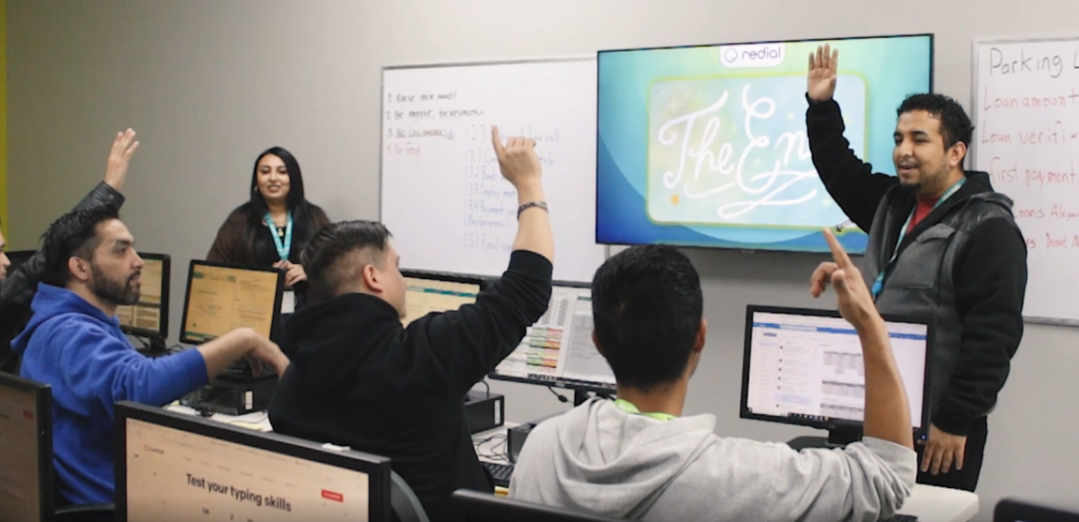
Technology has rewritten what employee training can look like. Cloud-based learning platforms, virtual classrooms, and gamified modules replace the outdated model of a two-week binder and a slide deck. Agents can complete micro-lessons between calls, managers can push updates instantly when a policy changes, and remote or hybrid teams get the same experience as on-site staff. AI-assisted coaching tools also review call recordings automatically and surface the moments that matter most, freeing supervisors to spend their time on the coaching itself, not the searching. Redial’s Voice AI services plug directly into this workflow.
There is a clear efficiency case as well. According to how HR leaders measure the return on training investment, every dollar spent on cultivating staff potential generates measurable returns; centralized digital learning compounds that ROI by removing travel, printed material, and repeated instructor time from the cost base. That savings can be reinvested into shorter, higher-frequency refreshers, which is what modern adult learners actually retain.
In-house training vs. outsourced (BPO-run) training
| Factor | In-house | Outsourced (BPO) |
| Setup time | 3 to 6 months to build a curriculum from scratch | 2 to 4 weeks to plug into an existing system |
| Cost model | Fixed: instructors, LMS, content, HR overhead | Variable: rolled into the per-seat rate |
| Scalability | Slow, tied to hiring cycles | Fast, ramps with headcount on the same curve |
| Technology stack | Client buys and maintains it | Provider maintains it as part of the service |
| Best for | Deep product knowledge on a proprietary platform | Volume, multilingual, or seasonal operations |
Role Play as a Core Training Method
Role play remains one of the highest-impact techniques in employee training. It works because it forces agents to practice the exact behaviors they will need on a live call: reading a customer’s tone, staying calm under pressure, and moving a conversation toward resolution. Watching a training video is passive; running through a scripted escalation with a peer is active, and active learning sticks.
Effective role play is designed, not improvised. Trainers should build scenarios around real customer complaints, escalation calls, refund disputes, and product objections, then debrief in real time on what worked and what did not. Recording those sessions and reviewing them alongside live call samples gives new hires a fast, safe on-ramp before they take their first real call. For a deeper look at the underlying competencies, see the skills every contact center agent should master.
Metrics That Prove Training Actually Works
Data separates a strong program of employee training from wishful thinking. Every learning initiative should be tied to a small set of metrics that show whether behavior on the floor is actually changing. If the KPIs do not move within a defined window (typically 60 to 90 days after a coaching cycle), the curriculum, the coaching, or both need adjustment.
The four essentials are:
- First Call Resolution (FCR): the share of issues resolved without a callback or transfer. This is the fastest signal that product and process learning is working.
- Average Handle Time (AHT): how long the average interaction takes. Trending down (without hurting CSAT) means agents are becoming more efficient.
- Customer Satisfaction (CSAT): post-call score. If FCR is up but CSAT is flat, soft-skills coaching is the gap.
- Employee Satisfaction (ESAT): agents who feel supported by their program stay longer, and tenure has a direct line to CSAT.
For the operational rhythm around these numbers, our post on why teams need continuous training walks through the weekly cadence that keeps them trending in the right direction.
Emerging Trends: AI, VR, and Data-Driven Coaching
The next wave of employee training is powered by artificial intelligence. AI-driven QA reviews 100% of calls instead of the 2 to 5% a human QA team can sample, and it surfaces coaching moments the same day the call happened. Chatbots and voice bots also serve as practice partners, letting new agents run through hundreds of realistic simulations before they take a live customer.
Virtual reality and augmented reality push this further. Immersive simulations let trainees experience difficult service situations firsthand, in a controlled setting where mistakes carry no cost. Combined with data analytics on real call recordings, coaching becomes precise: a supervisor no longer says “work on empathy,” they show a specific 45-second clip where empathy would have changed the outcome.
Building a Positive Work Culture During Training
Culture is inseparable from any serious plan for employee training. Agents form their first impression of the company during onboarding, and that impression predicts whether they will still be on the floor six months later. Recognition programs, clear career paths, and managers who coach rather than surveil are what turn a learning program into a retention program. For teams looking to scale culture across borders, a nearshore call center partner can extend that same environment to talent in Mexico, South Africa, or the Philippines.
The data backs this up: research on contact centre knowledge access and burnout found that only 15% of contact center staff feel information is accessible to them, and more than 30% of contact centers never survey their employees. Environments that solve for both (easy access to knowledge, and a real listening loop) are the ones that convert new hires into tenured agents.
Ready to build a call center team that customers actually thank?
Redial BPO runs nearshore and offshore operations built on the exact framework in this article: structured curriculum, AI-assisted coaching, and a culture that keeps agents on the floor longer. If you need a partner who takes learning seriously from day one, we should talk.>> Get a free quote | Talk to our team | See our full call center solution
Frequently Asked Questions About Employee Training
1. Why is employee training so important?
Because agents are the voice of your brand on every call. Well-prepared agents resolve more issues on the first contact, protect customer lifetime value, and lower attrition, which compounds savings on hiring and onboarding across the year.
2. How long should employee training last?
An effective program is not a fixed number of days. Initial onboarding typically runs two to four weeks, followed by nesting on the floor with a coach, then ongoing weekly or bi-weekly coaching for as long as the agent is with the company. Learning is a rhythm, not a project with a finish line.
3. How does technology support employee training?
Modern platforms centralize onboarding content, gamify practice, and use AI to review calls and surface coaching moments. Voice AI, LMS platforms, and analytics tools shorten ramp time, standardize the experience across sites, and free supervisors to coach instead of monitor.
4. What metrics measure the success of employee training?
The four essentials are First Call Resolution, Average Handle Time, Customer Satisfaction (CSAT), and Employee Satisfaction (ESAT). If FCR and CSAT are trending up and AHT is stable or dropping without hurting quality, the program is working.
5. What is the difference between employee training in a call center and general corporate training?
Call center programs are built around live customer interactions, so the curriculum blends product knowledge, communication under pressure, and real-time use of tools like CRMs and dialers. General corporate training tends to focus on role-specific skills without the constant customer-facing element, which is why call centers need shorter, more frequent coaching cycles tied to metrics like FCR and CSAT.
Award winning marketing leader in brand, creative and digital with over 15 years of experience in SaaS, enterprise technology, and digital design. Transitioned from a programmer to UI/UX designer to a creative leader, successfully revitalizing global brand systems, leading award-winning campaigns, and building high-performing teams. Specialize in developing Figma-driven design systems, managing creative operations, and aligning brand storytelling with business strategy. Exceled at collaborating with sales, marketing, and product teams to execute cohesive brand experiences across campaigns, events, and platforms. Passionate about combining creativity and process to drive impact, efficiency, and engagement.