

When Holiday Debt Shows Up on the Books: The 90-Day Lag
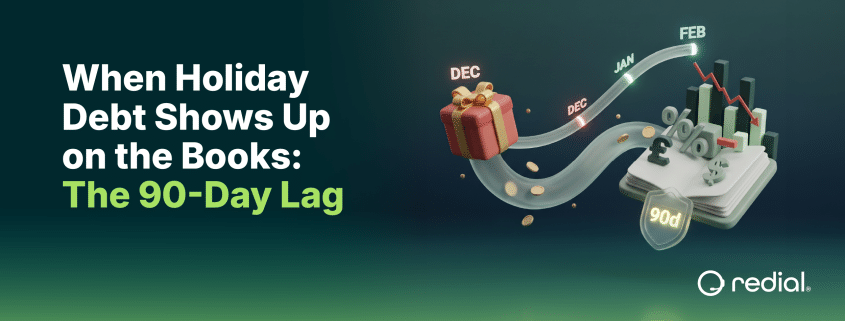
December is when the money is spent. It is not when the trouble appears. A lender watching its portfolio in January sees balances up and payments arriving, and concludes the season went well. The accounts that will not keep up are already in the book, but nothing marks them yet. Holiday debt delinquency surfaces roughly ninety days after the purchase, pushed back by the ordinary mechanics of billing cycles, due dates and reporting.
That lag matters for one reason: recovery capacity planned around the holidays arrives in the wrong month. The pressure lands in late winter and early spring, at the same moment many households receive the one lump sum of the year that could clear the balance.
The Spending Is Visible. The Strain Is Not.
The exposure is widespread. LendingTree’s December 2025 holiday debt survey of 2,032 consumers found that 37% took on holiday debt, averaging $1,223, and that 63% of those borrowers expected to need three months or longer to pay it off.
Three months is the point. A borrower who needs a quarter to repay has no margin for anything else going wrong in that quarter, and winter brings its own bills.
The first quarter also flatters the portfolio. The New York Fed’s household debt report for the first quarter of 2026 recorded credit card balances falling by $25 billion, a decline the report describes as seasonal, while the flow of card balances into serious delinquency edged up to 7.10% from 7.04% a year earlier.
So the headline number improves while the tail worsens. Balances fall because most customers are paying. The minority who cannot are hidden inside the average, and the reports that would expose them have not been generated yet.
This is why experienced recovery teams distrust a quiet January. A quiet month after heavy spending is not evidence of health. It is the gap between cause and effect.
Ninety Days, Step by Step
The lag is not a mystery. It is five ordinary events, each waiting for the one before it.
| Step | Approximate timing | What happens | What the lender sees | Recovery posture |
|---|---|---|---|---|
| 1. Purchase | Day 0 (late November to December) | Holiday spending goes on the card or loan | A higher balance. Nothing unusual | None. Prepare segments and contact details |
| 2. Statement | Around day 15 to 30 | The cycle closes and the higher minimum is billed | A normal statement | None. Confirm reminders are switched on |
| 3. First miss | Around day 40 to 60 | The due date passes without the minimum payment | An account a few days past due, not yet reported | Best moment to make contact. Small amount, cooperative customer |
| 4. Delinquency | Around day 70 to 90 | The account reaches 30 days past due and is reported | The first appearance in delinquency reports | Structured outreach and payment arrangements |
| 5. Recovery window | Day 90 to 150 (late winter to spring) | Accounts roll toward 60 and 90 days, or cure | Roll rates climb. Refund deposits begin to arrive | Full capacity. Prioritize accounts most likely to pay |
The spacing is not arbitrary. The CFPB’s explanation of card grace periods notes that issuers must deliver a bill at least 21 days before the payment is due, which is what places the first possible miss roughly six to eight weeks after the purchase. The exact days shift with each lender’s billing cycle; the order of the steps does not.
Step 3 is the one most operations miss. The account is days late, the amount is one minimum payment and the customer has not yet decided to stop answering. But step 3 produces no report. By the time step 4 puts the account on a delinquency list, a month of the easiest recovery has gone.
That is the planning error in one line: teams staff to the report, and the report is thirty days behind the problem. For lenders without spare capacity in late winter, the lag is the practical test for deciding when outside recovery capacity makes sense, because the need is predictable, seasonal and short.
The cost of that lost month is not linear. An account one payment behind needs one payment to be current again. An account two payments behind needs two, plus late fees, from a household that could not find one. Every step to the right on the timeline makes the cure more expensive for the borrower and less likely for the lender.
Not every account at step 5 deserves the same effort. As volumes rise, ranking accounts by likelihood to pay keeps agents on the conversations that can still end in an arrangement.
Planning Capacity for the Right Month
The useful response is to move every decision about ninety days earlier than instinct suggests.
- Decide in the fourth quarter. Hiring and training for February cannot start in February
- Reach out at the first miss. A reminder in the creditor’s own voice, with a way to pay or set a plan, before the account is reported
- Offer arrangements, not demands. A borrower three months into holiday debt can usually manage a plan and rarely a lump sum, until a refund arrives
- Hold capacity through spring. The window in step 5 stays open for weeks, not days
None of this means pressing customers harder. The accounts in question belong to people who were current in November and intend to be current again. An early, courteous call that offers a plan is a service to that customer as much as a recovery tactic, and it is usually received that way.
Early contact is a different activity from late-stage collection, and it is worth being exact about where early outreach in the creditor’s name ends and a third party takes over. Most of what the timeline calls for sits on the early side of that line.
Accounts that are not reached in the window do not stand still. They age, and the economics change at every step, which is the story of what happens to accounts that reach charge-off.
In-house teams feel the lag hardest because it collides with constraints they already have. Answer rates are low, experienced agents are hard to keep, and the seasonal peak arrives without a seasonal budget. Those are the three pressures squeezing in-house recovery teams, and late winter is when all three meet.
Conclusion
Holiday debt becomes a recovery problem about ninety days after it becomes a balance. The first missed payment is the best moment to act and the one moment no report announces. Lenders that plan capacity around December are ready a quarter too early or, more often, a month too late. Mapping your own billing cycle onto the five steps shows which weeks actually need people. If those weeks fall in late winter and your team is sized for an average month, that is the gap to close before the season starts.

FAQ: Holiday Debt Delinquency
1. When does holiday debt turn into delinquency?
Usually about 90 days after the purchase. The statement closes a few weeks after the holiday spending, the payment comes due several weeks after that, and an account is counted as 30 days past due a month after the missed payment. Late-December purchases therefore tend to surface as delinquency in late winter and early spring.
2. Why don’t credit card delinquencies rise in January?
Because billing cycles delay them. In January most holiday balances have only just appeared on a statement and the first payment is not yet due. Card balances typically fall in the first quarter as consumers pay down, and the accounts that cannot keep up only show as past due weeks later.
3. When should lenders add recovery capacity after the holidays?
Before the first missed payments, which means preparing in December and January and having agents ready for February through April. Capacity added after delinquency appears in reports arrives a month late, when the easiest accounts to cure have already rolled forward.
4. What is the best time to contact a customer who missed a post-holiday payment?
Early, in the first days after the missed due date, while the amount owed is small and before the account is reported as 30 days past due. Contact at this stage is usually made in the creditor’s own name and is far more likely to end in a payment arrangement than contact made after 60 or 90 days.