
RedialBPO
  • Services
    • Call Center Solutions
    • Contact Center Solutions
    • Core Services
      • Accounts Payable and Receivable
      • Back Office Support
      • Customer Service
      • Debt Collection
      • Insurance Verification
      • Order Taking Service
      • Sales Service Inbound and Outbound
      • Tech Support
      • Upselling and Cross-Selling
      • Voice AI Services
      • Workflow Automation Services
    • Additional Services
      • Appointment Setting
      • Data Processing
      • Email Request Services
      • Lead Generation
      • Live Chat Services
      • Transfer Service
    • BPO Services
    • BPO Nearshore Services
    • BPO Offshore Services
  • Industries
    • Automotive Services
    • Financial Services
    • Healthcare Services
    • Hospitality and Travel Services
    • IT Services
    • Logistics Services
    • Real Estate & Property Management
    • Retail & eCommerce Services
    • Telecom Services
    • Utility and Energy Services
  • Locations
    • Mexico
    • South Africa
    • Philippines
    • Follow-The-Sun Model
  • News & Events
    • Blog
    • Events
  • Company
    • About Us
    • Our Team
    • Media
    • Contact Us
  • Join Redial!
  • Get a Free Quote
  • Menu Menu
holiday season staffing lead time
Dyamond Dickenson

The Hiring Clock: How Far Ahead Capacity Decisions Have to Happen

September 18, 2026/in Customer Service /by Dyamond Dickenson

Every October, some retail team finds out the hard way that “we’ll hire when volume picks up” was never actually a plan. By the time order volume makes the staffing gap obvious, the clock that mattered has already run out. Holiday season staffing lead time isn’t measured in the days before Black Friday, it’s measured in weeks before that, and most of those weeks are already behind us by the time a retailer starts asking the question seriously.

I have this conversation with retail teams every August, and the ones who wait until October to have it are always working from a shorter list of options than the ones who started earlier.

Why the clock starts earlier than it feels like it should

Retailers planned to hire between 265,000 and 365,000 seasonal workers for the most recent holiday season, according to National Retail Federation data, the lowest total in more than 15 years, down from 442,000 the year before. Fewer seasonal hires overall doesn’t mean less pressure on the ones a retailer does need, it means the labor pool a retailer is competing for is smaller, which makes waiting even more expensive than it used to be.

The government’s own data on the shape of this cycle backs up why timing matters as much as headcount. The buildup and the subsequent layoff both follow a predictable calendar pattern, hiring concentrated from October through December, followed by layoffs in January and February, according to Bureau of Labor Statistics research on seasonal retail employment.

That predictability is exactly what makes late planning inexcusable: this isn’t a surprise pattern retailers are reacting to for the first time. It repeats every year, on roughly the same calendar, and the retailers caught flat-footed are the ones who treated this year’s version as a new problem instead of a known one.

The pattern holds on the customer service side just as reliably as it does on the store floor. Contact volume doesn’t ramp up gradually starting in November, it steps up sharply the moment a major promotional event hits, and stays elevated through the last week of December before dropping off just as fast.

A team calibrated for October’s ticket volume is, by definition, undersized for the week Black Friday actually happens, and no amount of overtime in the moment closes a gap that size.

What actually has to happen before the volume hits

Training a seasonal or overflow agent to handle order status, returns and product questions at the standard a retailer’s regular customers expect takes real time: Sourcing candidates, running them through product and systems training, and getting them comfortable enough to handle a real conversation without escalating everything back to a supervisor who’s already stretched thin.

Compress that timeline and the quality gap shows up exactly when it matters most: During the highest-volume, highest-visibility weeks of the year, when a slow or wrong answer is far more likely to become a public complaint than it would be in a quiet month.

That’s why the practical question isn’t “how many people do we need,” it’s “when do we need to have started.” Coverage built around when order volume actually peaks, rather than a headcount plan finalized once and left alone, is what separates a program that holds through the surge from one that only looks adequate on a staffing spreadsheet.

A retailer running the order status, returns and peak-season overflow work retail programs actually need to absorb has to build that capacity with enough runway that training is finished, not just started, before the first heavy week arrives.

What the lead time actually buys

The advantage of planning early isn’t just avoiding a scramble, it’s access to a delivery model that can flex capacity up for the peak weeks and back down afterward without triggering a layoff cycle, which is a fundamentally different staffing tool than a purely domestic hire-and-release cycle. That flexibility only works if it’s built into the plan early enough to actually train the people who’ll be answering calls and chats during the peak.

Volume that outpaces even a well-planned team doesn’t have to become a service failure either. AI-assisted overflow handling for the volume a human team can’t fully absorb can catch the routine order-status and tracking questions that make up a large share of peak-season contact volume, freeing trained agents for the conversations that actually need a person.

Retailers evaluating any partner for this kind of seasonal support should work from the broader checklist for evaluating any call center partner before assuming a general-purpose vendor can absorb a retail-specific volume spike without retail-specific preparation.

If your team is headed to Shoptalk Fall this September, capacity planning for this exact window is a conversation worth having in person — find us at the show or reach out before it.

The takeaway

The retailers who come through peak season without a service collapse aren’t the ones who reacted fastest once volume spiked. They’re the ones who treated the hiring clock as already running the day the previous season ended, and built the next one’s plan while this year’s numbers were still fresh enough to actually use.

Talk to a specialist

Peak-season capacity, staffed with runway to train

Dyamond Dickenson, Client Services Executive at Redial BPO

Dyamond Dickenson

Client Services Executive · Retail & E-Commerce

Redial’s retail teams handle order taking and order status, returns and exchanges, and peak-season volume absorption — staffed and trained with enough runway to hold through the surge, not scramble during it.

Book time with Dyamond → See how it works

FAQ: The Hiring Clock: How Far Ahead Capacity Decisions Have to Happen

1. How far in advance should retailers start holiday staffing decisions?

raining a seasonal or overflow agent to handle real customer conversations takes weeks, not days, so the planning window has to start well before volume actually rises. Waiting until October, when the pressure becomes visible, generally means starting the process behind where it needed to be.

2. Why does seasonal hiring keep getting harder even when retailers plan the same way every year?

The National Retail Federation’s most recent holiday hiring forecast put planned seasonal hires at their lowest level in more than 15 years, meaning retailers are competing for a smaller seasonal labor pool even as peak-season volume itself hasn’t shrunk. That combination makes early planning more valuable, not less, than in years with a larger available labor pool.

3. Does holiday customer service volume follow a predictable pattern?

Yes. Bureau of Labor Statistics data on seasonal retail employment shows hiring concentrated from October through December and layoffs concentrated in January and February — a pattern that repeats every year. Contact volume on the customer service side follows a similarly sharp, predictable ramp tied to major promotional events rather than a gradual rise.

4. What’s the advantage of a flexible staffing model over hiring seasonal employees directly?

A flexible delivery model can scale capacity up for peak weeks and back down afterward without the retailer running its own hire-and-release cycle each year, which avoids both the recruiting effort and the training ramp-up that comes with building a new seasonal team from scratch every season.

5. Can AI handle holiday customer service volume instead of hiring more staff?

AI-assisted tools are well suited to routine, high-volume questions like order status and tracking, which make up a large share of peak-season contact volume. They work best paired with trained human agents for the conversations that need judgment, rather than as a full replacement for seasonal staffing.

https://redialbpo.com/wp-content/uploads/2026/09/Blog-header-Capacity-decisions.webp 490 1280 Dyamond Dickenson https://redialbpo.com/wp-content/uploads/2026/04/rbpo_logo_color_large_black_600x209-300x105.png Dyamond Dickenson2026-09-18 08:08:542026-09-18 08:09:17The Hiring Clock: How Far Ahead Capacity Decisions Have to Happen
outsourcing charged-off account recovery
Yessica Peña

Why US Banks Are Rethinking How They Recover Charged-Off Accounts

September 9, 2026/in Collections service /by Yessica Peña

A bank that wrote off $10 million in credit card balances last quarter isn’t done with that money, it’s just moved it into a different phase of recovery, one that most banks are quietly restructuring right now. Outsourcing charged-off account recovery used to be a decision community banks made reluctantly, after in-house collections had clearly stopped working.

That’s changing. More banks, including some that never seriously considered it before, are rethinking the assumption that recovery has to stay in-house at all. I hear a version of the same question from almost every bank I talk to this year, and it isn’t “should we outsource”, it’s “why haven’t we already“.

The recovery math banks can no longer ignore

The charge-off rate on credit card loans at all commercial banks climbed to 4.03% in the fourth quarter of 2025, according to Federal Reserve data, and the picture is worse for banks outside the 100 largest, where the rate runs several points higher. That’s not a one-quarter blip, it’s a sustained level that keeps a growing pool of charged-off balances sitting on the books longer than banks are staffed to work them.

The volume problem compounds with a timing problem. Charge-offs lag the delinquency that caused them by three to four quarters, which means the accounts hitting recovery teams this year reflect stress that started building over a year ago, and the accounts still working through delinquency now will land on someone’s desk well into next year. A bank sized to handle last year’s charge-off volume is already behind on this year’s, and the gap compounds every quarter it goes unaddressed.

That lag is exactly why a static, once-a-year staffing plan for recovery doesn’t hold up. A team built to handle a known, historical charge-off level is structurally unequipped for a volume that’s still climbing by the time next year’s budget gets set, and by the time the mismatch shows up in aging reports, the accounts that could have been recovered easily have already moved into the harder, more expensive-to-work tier.

This isn’t unique to any one bank, it’s an industry-wide pattern. For the fuller data behind why that recovery gap keeps widening, the scale of the problem is worth understanding beyond any single institution’s numbers, since the same three structural forces are pressing on every bank running recovery the way it’s always been run. What differs from bank to bank isn’t whether the pressure exists: It’s how early each one recognizes it and how much runway that leaves for a considered decision instead of a rushed one.

Why more banks are looking outside their own walls

The instinct to keep collections in-house made more sense when the technology gap between doing it internally and outsourcing it was small. That gap has widened, and not in the direction that favors staying in-house. Banks overall have increased technology spending by roughly 65% over the past 15 years, and the technology budgets of the largest banks now run more than ten times those of regional banks, a differential that keeps widening as AI-driven tools become table stakes for effective recovery rather than a nice-to-have.

A regional or community bank trying to match that capability with an internal team, built and maintained at internal scale, is fighting an economics problem that has nothing to do with how good its collectors are. Predictive scoring, omnichannel contact strategy, and compliance-monitoring tools that a large bank can amortize across millions of accounts cost roughly the same to build for a bank working a few thousand.

This is the build-versus-buy math on recovering money already written off: Not whether an in-house team can do the work, but whether it can do it at the technology and scale level the current charge-off environment actually requires.

Getting that comparison right up front avoids the more common mistake, which is discovering the gap only after a year of underperforming recovery rates, by which point the accounts that could have been recovered have aged past the point where any partner, internal or external, can do much with them.

What the decision actually involves

The recovery model doesn’t look the same for every portfolio. How fintech lenders structure recovery for a portfolio that looks nothing like a traditional bank’s is a useful comparison point precisely because it shows how much the right approach depends on the underlying loan type, the borrower relationship, and how the account was originated in the first place, a one-size answer rarely fits both.

Two decisions sit underneath the outsourcing question itself, and skipping past them tends to produce a worse outcome than the outsourcing decision alone would. The first is the return-on-investment math behind that decision: What recovery actually costs to run in-house once training, technology, compliance overhead and management time are counted honestly, not just the visible headcount cost.

The second is the choice between keeping accounts in a bank’s own name or placing them with a specialist operating under its own name, which changes both the economics and the customer relationship risk in ways that aren’t always obvious until they’ve already played out. A bank protecting a long-term deposit relationship may prefer first-party placement even at a lower recovery rate; a bank prioritizing recovery yield on accounts it’s already written off may not.

The takeaway

Banks rethinking charged-off account recovery are really working through three separate decisions, not one broad “should we outsource” question:

  • The technology gap. In-house capability now competes against a technology budget roughly ten times larger, amortized across millions of accounts rather than a few thousand — a gap that has nothing to do with how skilled a bank’s own collectors are.
  • The real cost comparison. A fully loaded in-house cost includes training, technology, compliance overhead and management time — not just the headcount line most banks compare against an outsourced quote.
  • The account-placement model. First-party recovery protects the customer relationship; third-party placement often recovers more from accounts already written off. Which one wins depends on what the bank is actually protecting.

The banks getting ahead of this aren’t necessarily the largest ones. They’re the ones that stopped treating the recovery team’s staffing plan as fixed and started treating it as a number that has to move with the charge-off rate itself.

Talk to a specialist

The build-vs-buy math, worked through together

Yessica Peña, Client Services Executive at Redial BPO

Yessica Peña

Client Services Executive · Financial Services & Lending

Redial’s financial services teams handle collections and recovery, KYC and document verification, and account servicing — built to scale with your charge-off volume, not your last budget cycle.

Book time with Yessica → See how it works

1. Why are more banks outsourcing charged-off account recovery now?

Two pressures are converging: charge-off rates have climbed to 4.03% at all commercial banks as of Q4 2025 per Federal Reserve data, and the technology investment needed to recover those accounts effectively has grown well beyond what most regional or community banks can build internally at competitive scale.

2. What is the actual cost comparison between in-house and outsourced recovery?

An honest comparison has to include training, technology, compliance monitoring and management overhead on the in-house side, not just visible headcount cost. Comparing a fully loaded in-house cost against a per-account outsourced cost is the calculation that actually predicts which option is cheaper — a comparison many banks skip in favor of headcount cost alone.

3. What’s the difference between first-party and third-party debt collection for banks?

First-party collection keeps the bank’s own name on the account and the recovery effort; third-party placement moves the account to a specialist operating under its own name. The choice affects both the economics of recovery and the risk to the underlying customer relationship, and the right answer depends on what the bank is prioritizing — relationship retention or recovery yield.

4. Does the recovery approach differ for fintech lenders compared to traditional banks?

Fintech lending portfolios often differ in loan structure, borrower relationship, and origination method from traditional bank portfolios, which means a recovery approach built for one doesn’t necessarily transfer cleanly to the other. The underlying loan type shapes what an effective recovery model actually looks like.

5. How long does it take charge-offs to show up after a loan becomes delinquent?

Charge-offs typically lag the delinquency that caused them by three to four quarters. That lag means the volume hitting a recovery team today reflects financial stress that began building more than a year earlier, which is part of why static, once-a-year staffing plans struggle to keep pace.

https://redialbpo.com/wp-content/uploads/2026/09/BlogCover-USBanks.webp 460 1200 Yessica Peña https://redialbpo.com/wp-content/uploads/2026/04/rbpo_logo_color_large_black_600x209-300x105.png Yessica Peña2026-09-09 10:16:002026-09-11 16:03:58Why US Banks Are Rethinking How They Recover Charged-Off Accounts
Why Enrollment Season Punishes Understaffed Phone Lines
Dyamond Dickenson

Why Enrollment Season Punishes Understaffed Phone Lines

September 4, 2026/in Customer Service /by Dyamond Dickenson

Every fall, the same conversation happens on a healthcare or insurance customer service floor: hold times climb, abandoned calls spike, and the team that felt adequately staffed in August is suddenly underwater in October. Open enrollment call center staffing isn’t a problem that sneaks up — the calendar is fixed and public months in advance.

It punishes teams anyway, because the gap between “we’ll be fine” and “we’re drowning” is usually a staffing decision made too late to fix once the calls start coming in. I’ve watched this play out the same way with more than one client: the team that starts the staffing conversation in July looks nothing like the one still scrambling in mid-October.

The staffing math nobody plans around

The Centers for Medicare & Medicaid Services sets the same seven-week window every year: the fixed enrollment period CMS runs each fall, October 15 through December 7, when every Medicare beneficiary can review, switch, or drop coverage for the year ahead. That window isn’t a surprise. It’s published, predictable, and identical in structure year over year, which makes it strange how many phone lines still hit capacity in the first week of it.

The gap usually isn’t a lack of awareness. It’s a lack of lead time. Adding trained, licensed-adjacent staff to a healthcare or insurance support line takes weeks, not days: sourcing candidates, running them through product and compliance training, and getting them comfortable enough to handle a real member call without escalating everything. A plan built in September is already behind. A plan built in early August, with real hiring lead time built in, is the one that actually holds when volume hits.

The cost of getting the timing wrong isn’t abstract. A team that starts training new agents in late September is putting people on the phone with two, maybe three weeks of ramp-up behind them right as the highest-stakes calls of the year start coming in: a member trying to understand whether their doctor is still in-network, or whether a plan change affects a prescription they depend on.

Rushed training doesn’t just slow the call down. It shows up as a wrong answer given confidently, which is worse for the member and harder to walk back than a long hold time. The same lead-time problem shows up on the verification side of the house, where the staffing gap already straining insurance verification teams tends to compound with the enrollment-season call volume rather than existing separately from it: the same understaffed front line answers both kinds of calls.

Why the phone line becomes the bottleneck

The phone line is where every other part of open enrollment either holds together or falls apart. A member with a plan question, a benefits question, or a simple “did my enrollment go through” call is dealing with the day-to-day plan and benefits questions making up most of an insurance line’s volume during this window — not complex escalations, mostly, but a high volume of calls that all need to be answered promptly for a member to trust the process.

That trust is measurable, and it’s moving in the wrong direction. JD Power’s 2026 U.S. Medicare Advantage Study, based on responses from over 14,000 members, found overall satisfaction with Medicare Advantage plans fell to 611 on a 1,000-point scale this year, the second consecutive annual decline, with representatives and call center agents named as one of the eight factors the study measures directly. A member who can’t get through, or gets through to someone who can’t answer the question, isn’t a data point on a dashboard. They’re a renewal decision six weeks away.

The compounding problem is that open enrollment is exactly the window when a member is actively comparing options. A frustrating call during any other month is an annoyance the member absorbs and moves past. A frustrating call during open enrollment is a data point in the decision they’re actively making about whether to stay. The phone line isn’t just support during this window, it’s part of the product experience the member is evaluating.

What a staffing plan for this season actually requires

A plan that actually holds needs three things in place before the first week of the window, not during it:

  • Enough trained agents to cover the realistic peak, not last year’s average.
  • A way to flex capacity up without a multi-week hiring cycle when volume runs ahead of forecast.
  • A channel mix that doesn’t collapse onto the phone line alone when every other option gets tried first.

The same staffing math applies on the other side of the front desk. A healthcare provider fields its own version of this surge: patients calling to confirm whether a plan change affects their in-network status, whether a referral still holds, whether an appointment needs rescheduling around a new deductible.

The scheduling, billing and referral questions that keep a healthcare front desk busy this time of year spike on roughly the same calendar as the insurance line does, which means a plan built for one side of that relationship without the other is only half a plan.

A coverage model built around when the calls actually come in, rather than a fixed shift pattern built around a typical week, is the difference between a line that holds through the surge and one that only holds on paper. That’s the conversation I have most often with a healthcare or insurance team heading into this season, not “how many agents do you have,” but “when are they actually available relative to when your members are actually calling.”

None of this is unique to open enrollment specifically, the general playbook for handling a volume spike applies whether the surge comes from a holiday, a product launch, or a plan year. What’s different about this window is how little room there is to react once it starts: the surge is compressed into seven weeks, the deadline is fixed by federal regulation, and a member who can’t get through in week two doesn’t wait patiently for week five.

The takeaway

The teams that come through open enrollment without a service-level collapse are the ones who treated the staffing decision as a summer project, not a fall scramble. If your current plan for this season was built in the last few weeks, it’s worth a second look before the calls start.

Talk to a specialist

Staffed for the surge before it starts

Dyamond Dickenson, Client Services Executive at Redial BPO

Dyamond Dickenson

Client Services Executive · Healthcare

Redial’s healthcare teams handle patient scheduling and appointment setting, insurance verification and eligibility, and billing and claims inquiries — staffed with the lead time this season actually requires, not built after the surge starts.

Book time with Dyamond → See how it works

1. When does open enrollment call center staffing need to be in place?

Staffing and training take weeks, not days, so a plan needs to be built with enough lead time to have trained agents ready before October 15, when the Medicare Annual Enrollment Period opens. Teams that start staffing conversations in September are typically already behind; those that start planning by early August have the lead time to actually hold through the surge.

2. Why does hold time get worse specifically during open enrollment?

The enrollment window is fixed by federal regulation, October 15 through December 7, and compresses a year’s worth of plan questions, coverage confirmations, and enrollment status checks into seven weeks. Call volume rises sharply while, in many organizations, staffing hasn’t scaled to match, which is what produces the hold-time spike.

3. How does open enrollment affect member satisfaction with insurance plans?

J.D. Power’s 2026 U.S. Medicare Advantage Study found overall member satisfaction fell to 611 on a 1,000-point scale, with representatives and call center agents named as one of the factors measured. Because open enrollment is when members are actively deciding whether to switch plans, a poor phone experience during this specific window carries more weight than the same experience at another time of year.

4. Is the open enrollment staffing challenge specific to insurance, or does it affect healthcare providers too?

Both. Insurance lines field plan and benefits questions, while healthcare provider front desks field a related but distinct volume of scheduling, billing, and referral questions tied to the same enrollment calendar. A staffing plan built for one side without the other typically leaves a gap on the side that wasn’t planned for.

5. What’s the fastest way to add capacity for a call volume surge without a long hiring cycle?

A coverage model that can flex staffing to match when calls actually arrive, rather than a fixed shift pattern, is the most direct way to add capacity without a multi-week internal hiring cycle. That typically means either cross-training existing staff for overflow or working with a partner that already has trained capacity available on short notice.

https://redialbpo.com/wp-content/uploads/2026/08/Blog-Enrollment-Seasonv2_Blog-1200-x-460.webp 461 1201 Dyamond Dickenson https://redialbpo.com/wp-content/uploads/2026/04/rbpo_logo_color_large_black_600x209-300x105.png Dyamond Dickenson2026-09-04 16:00:252026-09-04 16:00:43Why Enrollment Season Punishes Understaffed Phone Lines
Debt Collection Industry Trends 2026
Redialers Insights

Debt Collection Industry Trends 2026: Why $70 of Every $100 Placed Is Never Recovered

July 29, 2026/in Collections service /by Redialers Insights

U.S. household debt hit $18.8 trillion in the first quarter of 2026, and the credit card serious-delinquency transition rate climbed to 7.10%, up from 7.04% a year earlier (Federal Reserve Bank of New York). Nearly 2.6 million student loan borrowers more than 120 days past due were transferred to the Department of Education’s Default Resolution Group in that same quarter alone (New York Fed).

On paper, this looks like a debt problem. It isn’t. According to Redial BPO’s newly released The State of Debt Collections 2026, somewhere between $70 and $80 of every $100 in delinquent debt placed with a collector is never recovered — and the report’s core finding is that this gap is overwhelmingly operational, not legal. The accounts are collectible. Most agencies simply aren’t reaching, engaging, or converting the people who owe them fast enough, or in the channel those people actually use.

For credit managers, collections leaders, and anyone evaluating an outsourcing partner right now, that distinction changes the entire conversation — from “how bad is the economy” to “how good is our operation.”

What the delinquency numbers actually mean on a collections floor

Delinquency data gets reported in aggregates, but the operational reality inside a collections floor is much narrower: can we get someone on the phone, and can we get them to commit to a payment before the account ages out of recoverability.

That’s the part breaking down. The average industry recovery rate on placed debt sits at roughly 20–30%, a benchmark that has held steady for years across agencies of every size (Kaplan Group). Meanwhile, the population of accounts flowing into collections keeps growing — not just consumer credit card debt, but federal student loans re-entering active collections, healthcare receivables, subscription and B2B commercial balances, and utility arrears across every major receivables category. Volume is rising while the tools most agencies use to make first contact are becoming less effective by the month. That’s the gap. It isn’t that debt is less legally collectible than it used to be — it’s that the traditional playbook for reaching a debtor no longer works reliably enough to close it.

Three debt collection industry trends widening the gap in 2026

Three forces are compounding at once, and Redial BPO’s State of Debt Collections 2026 report walks through each in detail.

People have stopped answering the phone. Eight in ten Americans say they generally don’t answer a call from an unknown number (Pew Research Center, December 2020), and that instinct has only hardened. In Truecaller’s most recent U.S. survey, 82% of Americans say they’ve ignored an important call or text in the past year for fear it was a scam — up sharply from 59% just two years earlier (Truecaller, 2026).

The FCC logged more than 50 billion robocalls in a single recent year (FCC TRACED Act Annual Report), and every one of them trains consumers to distrust an unfamiliar caller ID — including legitimate collectors calling about a real, owed balance. Redial BPO’s own research on why collection call answer rates have collapsed goes deeper on this dynamic, including how caller ID reputation and channel mix directly move contact rates.

The compliance perimeter is expanding, not simplifying. The FDCPA and Regulation F still govern the baseline, but 2026 stacked new layers on top of it. California’s SB 1286 and AB 1521 tightened state-level obligations for collectors operating there, and the state’s new Business and Consumer Services Agency launched July 1, 2026 under Secretary Rohit Chopra — the former CFPB director.

The agency does not create a state equivalent of the CFPB or expand authority California regulators already held; what it changes is coordination and prioritization across departments, at a moment when the federal footprint is contracting. At the federal level, the CFPB has meaningfully pulled back on enforcement and staffing under Acting Director Russell Vought even as it keeps its authority on the books — a pattern that tends to shift real enforcement risk toward the states and toward plaintiffs’ attorneys rather than eliminate it.

Layer on the FCC’s TCPA “revoke-all” rule, twice delayed and now carrying a January 31, 2027 compliance date, and the message for any collections operation is the same: the rules are not getting simpler, they’re getting more fragmented by jurisdiction. Redial BPO’s compliance guides break down the two rules doing the most day-to-day damage to underprepared agencies — FDCPA obligations and TCPA calling and texting limits.

Most agencies are years behind on the technology that would fix both problems. Only 18% of collection agencies were investing meaningfully in AI/ML as of 2024 — up from just 11% the year before, according to Bridgeforce’s industry survey (Bridgeforce, 2024). That’s real movement, but it means more than four out of five agencies are still running contact strategies built for a decade in which people actually answered unknown numbers. The agencies closing the recovery gap are the ones pairing omnichannel outreach with predictive contact scoring — exactly the kind of model Redial BPO details in its payment propensity scoring research.

Four criteria for choosing a collections partner in 2026

If the recovery gap is operational, the fix is operational too — and it starts with who you choose to run collections on your behalf. The State of Debt Collections 2026 report distils partner evaluation down to four criteria that separate agencies that move the recovery-rate needle from agencies that just add headcount.

1. Time-zone and real-time coverage alignment

A partner working hours behind your debtor population is a partner missing the exact windows when people are reachable — early morning before work, early evening after it. Look for coverage that mirrors your customers’ time zones, not your vendor’s home office, and the ability to shift contact windows in response to live answer-rate data rather than a fixed call schedule.

2. Native bilingual capability

English-only outreach quietly writes off a meaningful share of any U.S. debtor population. A partner with genuinely native — not scripted-translation — bilingual collections agents will out-contact and out-convert an English-only shop on the same book of accounts, particularly in states with large Spanish-speaking populations and increasingly explicit bilingual compliance expectations.

3. AI capability with evidenced outcomes, not a roadmap

“We’re building AI capability” is not the same as “we have AI capability driving measurable recovery-rate lift today.” Ask any partner to show real before/after contact-rate or recovery-rate numbers tied to a specific AI or predictive-scoring deployment — not a vendor deck. If they can’t produce a client-level number, they’re still on the roadmap, and your accounts will pay for the learning curve. Our guide to evaluating a collections BPO partner sets out the questions worth asking before a contract is drafted.

4. Mid-market operational fit

Enterprise-scale agencies are frequently built for volume, not for the account-level nuance mid-market creditors need — and boutique shops often can’t scale past a few thousand accounts without breaking. The right partner scales cleanly between those two extremes without forcing you into either an assembly line or a bottleneck. Redial BPO’s guide for SMBs and mid-market creditors covers how to size and structure that fit before you sign a contract, and our earlier breakdown of what to weigh when comparing collections providers covers the shortlisting stage.

The case for acting now rather than later

Every quarter an agency delays modernizing its contact strategy, more accounts age past the point where recovery is realistic — collections economics reward speed, and speed is exactly what a stale, single-channel contact model can’t deliver. At the same time, the compliance environment is only adding jurisdictions to track, not removing them, which means the operational cost of running collections in-house or with an outdated vendor keeps climbing even as recovery keeps falling.

The agencies that will separate from the pack over the next 12–24 months are the ones treating this as the competitive window the report identifies — the period during which AI-enabled, compliance-first outsourcing partners can meaningfully out-collect and out-comply everyone still running a decade-old playbook. Waiting for the “right time” to modernize is, in practice, a decision to keep collecting at 20–30% while a growing share of competitors don’t.

If that’s the conversation your organization needs to have, read The State of Debt Collections 2026 in full — or talk to us about what your recovery rate should look like.

Frequently asked questions

1. What is causing the debt collections crisis in 2026?

Three compounding pressures, none of them primarily legal. Rising delinquency volume across consumer, student loan, and commercial debt (NY Fed); a collapsing willingness among consumers to answer unfamiliar phone numbers (Pew Research, Truecaller); and a compliance landscape fragmenting across state and federal lines rather than consolidating. The debt collection industry trends 2026 has produced are contact, trust, and operational problems — not evidence that debt has become less collectible.

2. Why is the average debt recovery rate so low?

Because most agencies are still trying to reach debtors primarily by outbound phone call, in an environment where roughly eight in ten consumers don’t answer unknown numbers (Pew Research). Recovery rates of 20–30% (Kaplan Group) reflect a contact-rate problem more than a willingness-to-pay problem — accounts that could be collected simply aren’t being reached in time.

3. How is AI actually changing debt collection outcomes?

Agencies using predictive scoring identify which accounts are likeliest to pay and through which channel, then prioritize agent time accordingly instead of dialing sequentially through a list. Adoption is still early — only 18% of agencies had meaningfully invested by 2024 (Bridgeforce) — which means agencies that adopt now are competing against a majority that hasn’t caught up yet.

4. What compliance changes should collections leaders watch in 2026 and 2027?

The two firmest dates are California’s Business and Consumer Services Agency launch on July 1, 2026 under Secretary Rohit Chopra, and the FCC’s TCPA “revoke-all” rule taking effect January 31, 2027. Underneath both, expect continued state-level enforcement growth as the CFPB’s federal footprint contracts. Both dates are confirmed against primary sources; the “revoke-all” rule has been delayed twice already and remains under active FCC reconsideration, so verify its status close to publication.

5. How long does it take to outsource debt collection to a compliant, AI-enabled partner?

Timelines vary by account volume and complexity, but a well-structured partner should be able to stand up a dedicated, trained, compliance-audited team and begin working accounts within 60–90 days of contract signature — not the six-to-nine-month onboarding cycles common with larger, less specialized providers.

Sources and References

  • Federal Reserve Bank of New York, Quarterly Report on Household Debt and Credit, 2026:Q1 
  • Pew Research Center, Most Americans Don’t Answer Cellphone Calls From Unknown Numbers (December 2020) 
  • Truecaller, AI Scams Are Breaking the Way America Talks (2026) 
  • Federal Communications Commission, TRACED Act Annual Report to Congress 
  • Bridgeforce, Debt Collection Industry Trends and Insights 2024 
  • Kaplan Group, Collection Agency Success Rate 
  • Consumer Financial Protection Bureau, Debt Collection Practices (Regulation F) 
  • Office of Governor Gavin Newsom, Governor Newsom Appoints Rohit Chopra to Head New Business and Consumer Services Agency 
  • Consumer Financial Protection Bureau, The Director 
  • Redial BPO, The State of Debt Collections 2026 

https://redialbpo.com/wp-content/uploads/2026/07/Debt-collections-Blog-IMG.webp 460 1200 Redialers Insights https://redialbpo.com/wp-content/uploads/2026/04/rbpo_logo_color_large_black_600x209-300x105.png Redialers Insights2026-07-29 09:38:042026-07-29 09:38:15Debt Collection Industry Trends 2026: Why $70 of Every $100 Placed Is Never Recovered
CCW Las Vegas 22-25 June, 2026 - Redial BPO - Official Sponsor
Elder Gonzalez

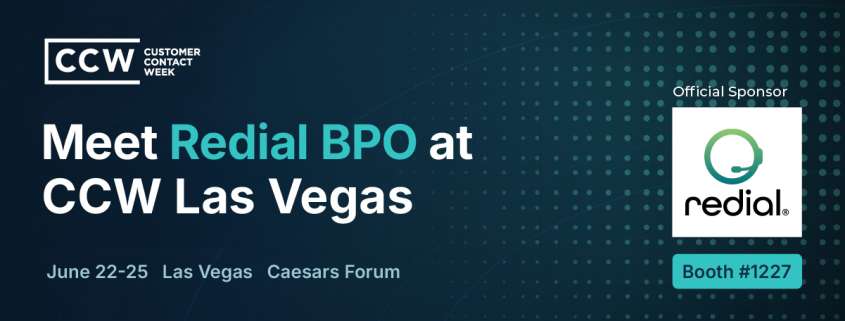
Redial BPO Is an Official Sponsor of CCW Las Vegas 2026 — and We’re Bringing Something Big

May 19, 2026/in Customer Service, Customer Support, CX and Services, Events, Live Chat, News, Omnichannel /by Elder Gonzalez

Customer Contact Week brings together the people actually solving the hardest problems in customer experience, and the conversations on that floor are some of the most useful of the year.

This year is different. Redial BPO is an Official Sponsor of CCW Las Vegas 2026 — and we’re using that platform to make the most significant announcement in our company’s history.

If you’re heading to Las Vegas from June 22–25, here’s what we’re bringing, why it matters, and why it’s worth finding us on the floor.

What Is CCW Las Vegas?

For those new to the show, Customer Contact Week Las Vegas is the world’s largest customer contact event. It draws over 8,000 professionals from across the U.S. and internationally, with hundreds of solution providers, speakers, and sessions covering every dimension of contact center operations and customer experience.


It is the definitive gathering for CCOs, VP of Operations, VP of CX, and contact center leaders making decisions about how their organizations will compete in an AI-first world.

Being an Official Sponsor at this level is not something we take lightly. It reflects where Redial BPO stands today as a company, and more importantly, what we’re committed to delivering to this industry going forward.


  Debuting at CCW Las Vegas 2026

Introducing our exclusive partnership with IzzyOps.

CCW Las Vegas 2026 is where we’re officially introducing our strategic partnership with IzzyOps, an AI Voice Agent Platform. It’s a significant milestone for Redial BPO — and there’s no better stage to debut it than in front of the largest gathering of contact center leaders in the world.

IzzyOps and Redial BPO partnership

Through our partnership with IzzyOps, we can now offer clients four integrated capabilities:

01

AI Voice Agents

24/7 coverage with customizable personalities and brand voice — your customers are always answered, regardless of volume or time of day.

02

Workflow Automation

A no-code builder for complex business processes and integrations — without the IT overhead or six-figure implementation costs of legacy platforms.

03

Flexible Human Escalation

A three-tier handoff: AI only, AI + your own team, or AI + Redial BPO agents. You choose the level of human involvement that fits your operation.

04

ROS Integration

When you bring in Redial BPO agents, the platform connects to ROS (the Redial Operating System) — the workflow orchestration, analytics, and quality management standing behind every agent handling your calls.

The old BPO model was built around headcount. This partnership is built around outcomes.

For companies watching after-hours calls go unanswered, lead backlogs grow untouched, or volume spikes overwhelm their teams — this is what we built together to solve.

See it live at Booth #1227 → Visit izzyops.com


What You’ll Walk Away With From a Meeting With Us

Here’s what a conversation with our team at CCW will give you:

  • A clear read on where the Redial BPO + IzzyOps partnership fits your tech stack — with no sales pressure if it doesn’t.
  • A live demo of the IzzyOps platform tailored to your vertical, whether that’s financial services, healthcare, retail, or contact center operations broadly.
  • A competitive reference point. We’ll show you honestly how our combined approach differs from enterprise AI platforms like Genesys or Five9, AI-only tools like Bland or Vapi, and traditional BPOs that treat AI as an afterthought.
  • Practical next steps. Not a deck and a follow-up sequence, but a real conversation about whether there’s a fit and what a pilot could look like.

    If that sounds like a conversation worth having, my calendar is open.

    We’ll See You in Las Vegas

    CCW Las Vegas has always been a market-signal event for me. The conversations on that floor tell you where the industry is headed and what buyers are still looking for.

    This year, I’m walking in to introduce something new: the operational depth of Redial BPO paired with the AI-first architecture of IzzyOps.

    Come find us at Booth #1227, book a meeting in advance, or just stop me on the floor. I’m always up for a real conversation.


    Want to learn more about how Redial BPO approaches customer experience outsourcing and nearshore contact center solutions?
    Explore our services or get in touch with our team directly.


    Frequently Asked Questions

    1. What is Redial BPO’s role at CCW Las Vegas 2026?

    Redial BPO is an Official Sponsor of CCW Las Vegas 2026, exhibiting June 22–25 from Booth #1227, with a 30-second commercial running on the entrance billboard. The event marks the public debut of Redial BPO’s strategic partnership with IzzyOps, an AI Voice Agent Platform.

    2. What is the Redial BPO and IzzyOps partnership about?

    IzzyOps is an AI Voice Agent Platform built by contact center practitioners. Through this strategic partnership, Redial BPO now offers clients four integrated capabilities: AI voice agents, no-code workflow automation, flexible human escalation, and ROS integration at the Redial BPO tier. At CCW Las Vegas, the team will run live on-floor demos of the combined solution throughout the event.

    4. What is an AI Voice Agent Platform?

    An AI Voice Agent Platform answers and makes phone calls using AI voice agents — software that holds a natural, two-way conversation instead of reading from a rigid menu. A capable platform handles routine work end to end: answering common questions, qualifying and routing leads, booking appointments, and capturing after-hours calls. The goal isn’t to remove people from customer conversations — it’s to let AI cover the high-volume, repeatable calls so your team spends its time where human judgment matters.

    5. How is an AI voice agent different from a traditional IVR or “press 1” phone menu?

    A traditional IVR forces callers down a fixed decision tree and breaks the moment a need doesn’t fit a preset option. An AI voice agent listens to what the caller actually says, in their own words, and responds in context — asking follow-up questions, pulling in account or order details, and completing the request, or handing off cleanly when it can’t. For the caller, it feels like talking to a knowledgeable person rather than navigating a machine.

    6. Will AI voice agents replace our human agents?

    No, and that’s deliberate. IzzyOps uses a three-tier handoff: the AI handles what it can; calls that need a person route to your own team; and, if you choose, they route to Redial BPO’s agents. You decide how much human involvement makes sense for your operation. The goal is to take repetitive, after-hours, and overflow volume off your team’s plate — not to remove the people your customers sometimes need to reach.

    7. What is ROS?

    ROS (the Redial Operating System) is the layer that powers the Redial BPO tier of the escalation model. It applies specifically when you choose to route calls to Redial BPO agents — it’s the Tier 3 capability in the three-tier handoff, not something required to use the IzzyOps platform itself.

    8. How can I book a meeting with Redial BPO at CCW Las Vegas 2026?

    You can book a meeting with our team in advance through our contact page. Elder Gonzalez (VP of Client Services) and Jason Heil (CEO) will both be present at the event for 1:1 conversations. Meeting slots are limited, so we recommend booking ahead of the event if you want a dedicated time.

    https://redialbpo.com/wp-content/uploads/2026/05/image-2.jpeg 461 1201 Elder Gonzalez https://redialbpo.com/wp-content/uploads/2026/04/rbpo_logo_color_large_black_600x209-300x105.png Elder Gonzalez2026-05-19 12:59:132026-05-22 13:47:24Redial BPO Is an Official Sponsor of CCW Las Vegas 2026 — and We’re Bringing Something Big

    Search our CX Blog

    Recent Posts

    • shoptalk fall 2026Shoptalk Fall 2026: Getting Ready for Peak Season CXSeptember 10, 2026 - 3:24 pm
    • Fintech customer service outsourcingFintech customer service outsourcing in 2026August 26, 2026 - 9:18 am
    • Eligibility verification denialsWhy Claim Denials Spike When Eligibility Checks Happen Too LateAugust 7, 2026 - 2:48 pm
    • Promotional banner for the Dykem a 2C26 13th Annual DSO Conference: July 15–17, 2026 in Denver, CO with calendar and location icons and the Redial logo.Redial BPO Heads to the Dykema DSO Conference 2026 — Denver, July 15–17July 2, 2026 - 10:09 am
    • CCW Las Vegas 22-25 June, 2026 - Redial BPO - Official SponsorRedial BPO Is an Official Sponsor of CCW Las Vegas 2026 — and We’re Bringing Something BigMay 19, 2026 - 12:59 pm

    Categories

    • Awards
    • BPO
    • Business Process Outsourcing
    • Call Center
    • Collections service
    • Customer Service
    • Customer Support
    • CX and Services
    • Events
    • Healthcare
    • Industries
    • Insurance Verification
    • Live Chat
    • News
    • Omnichannel
    • Redial Culture

    PCI Logo Redial BPO

    Nearshore & offshore call-center teams that protect your brand — PCI DSS and HIPAA-compliant, and ready to scale with your volume.

    Services

    • Customer Service
    • Technical Support
    • Inbound & Outbound Sales
    • Debt Collection
    • Back-Office Support
    • Lead Generation
    • Live Chat & Email
    • All Services →

    Industries

    • Financial Services
    • Healthcare
    • Retail & E-commerce
    • Technology & SaaS
    • Telecommunications
    • Travel & Hospitality
    • Logistics
    • All Industries →

    Locations

    • Mexico
    • South Africa
    • Philippines
    • All Locations →

    Company

    • Leadership
    • Blog
    • Contact Us
    • Join Redial!
    • Get a Quote
    Redial BPO Logo

    © 2026 Redial. All Rights Reserved.

    • Privacy Policy
    • Terms of Use

    Scroll to top