

RedialBPO
  • Services
    • Call Center Solutions
    • Contact Center Solutions
    • Core Services
      • Accounts Payable and Receivable
      • Back Office Support
      • Customer Service
      • Debt Collection
      • Insurance Verification
      • Order Taking Service
      • Sales Service Inbound and Outbound
      • Tech Support
      • Upselling and Cross-Selling
      • Voice AI Services
      • Workflow Automation Services
    • Additional Services
      • Appointment Setting
      • Data Processing
      • Email Request Services
      • Lead Generation
      • Live Chat Services
      • Transfer Service
    • BPO Services
    • BPO Nearshore Services
    • BPO Offshore Services
  • Industries
    • Automotive Services
    • Financial Services
    • Healthcare Services
    • Hospitality and Travel Services
    • IT Services
    • Logistics Services
    • Real Estate & Property Management
    • Retail & eCommerce Services
    • Telecom Services
    • Utility and Energy Services
  • Locations
    • Mexico
    • South Africa
    • Philippines
    • Follow-The-Sun Model
  • News & Events
    • Blog
    • Events
  • Company
    • About Us
    • Our Team
    • Media
    • Contact Us
  • Join Redial!
  • Get a Free Quote
  • Menu Menu
Everest Group PEAK Matrix
Elder Gonzalez

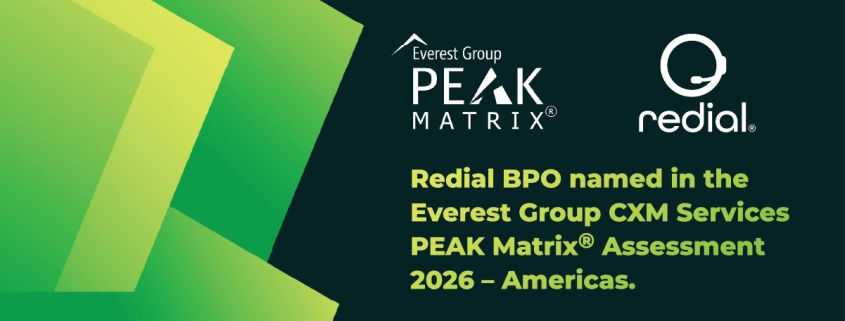
On the Map: Redial BPO Named an Aspirant in the Everest Group CXM Services PEAK Matrix® 2026

September 3, 2026/in Call Center /by Elder Gonzalez

Everest Group has published its Customer Experience Management (CXM) Services PEAK Matrix® Assessment 2026, and Redial BPO is in it — named an Aspirant in the Americas matrix, among 63 CX providers assessed across the Americas, EMEA, and APAC.

We want to talk about what that means, including the parts that are less flattering, because a milestone explained honestly is worth more than one inflated.

What the PEAK Matrix® actually measures

The PEAK Matrix® is Everest Group’s framework for assessing service providers. It plots each one on two axes.

The vertical axis is market impact: how many clients a provider serves and how fast that is growing, how diverse its client and revenue base is across geographies and engagement types, and — the one we care most about — the value clients report actually receiving.

The horizontal axis is vision and capability: strategy and roadmap, the depth and breadth of services offered, investment in innovation such as technology IP and domain knowledge and partnerships, and delivery footprint.

What makes the assessment carry weight with buyers is how it is built. Everest Group works from an analyst RFI process, its own transaction intelligence database, provider disclosures, and direct conversations with the enterprises actually buying CX services. In other words, a provider cannot talk its way onto the chart. The inputs are largely other people’s experience of us.

Providers land in one of three groups: Leaders, Major Contenders, or Aspirants.

Why we are proud of a starting position

We are an Aspirant. That is the entry tier, and we are not going to describe it as anything else.

Here is why it still matters. Redial BPO started in 2017. On that same chart are organizations with decades of history, tens of thousands of employees, and household-name clients. Being assessed against them, on identical criteria, by analysts who spend their days talking to CX buyers, means our work is now visible at the level of the industry rather than the level of an individual deal.

For enterprises evaluating CX partners, this matters in a practical way. Sourcing teams and advisors build shortlists from frameworks like this one. Providers who are not on the chart are frequently never considered. As of this assessment, we are in the room.

And a starting position is a measurable one. The PEAK Matrix is published annually. Where we sit today is now a public baseline — and we intend to move it.

The market is being rewritten while we climb

It would be strange to write about the future of CX right now without talking about AI.

Automation is changing which contacts reach a human, what those contacts look like when they do, and what a support program costs to run. Some of the assumptions this industry was built on are being retired in real time. The providers who struggle will be the ones whose scale makes them slow to change.

We think our size is an advantage here. We are large enough to run serious enterprise programs across Mexico, South Africa, and the Philippines, and small enough to redesign a workflow in weeks rather than quarters. Our strategic partnership with IzzyOps, an AI-first contact center platform, is central to that: bringing AI into operations in a way that makes agents better at the work rather than merely cheaper to employ.

Innovation and investment is one of the dimensions the PEAK Matrix weighs. It is also, independent of any framework, the thing that will decide which CX providers still matter in five years.

Who earned this

Two of the criteria in the assessment are value delivered and market impact. Both are, underneath the terminology, a record of what our people did.

They are the team leads coaching one more call at the end of a shift. The trainers who rebuilt a curriculum over a weekend because a client changed direction. The workforce analysts who spotted a volume spike before it became a service level breach. The agents who hit a target and then asked how to move it further. The recruiters, IT teams, and quality analysts who make all of it possible.

To every Redialer across Mexico, South Africa, and the Philippines: this assessment is a description of your work. Thank you.

What comes next

We are proud to be on the map. We are not planning to stay where we landed on it.

That means continued investment in our people and our technology, deeper AI capability through our work with IzzyOps, and the same standard on every interaction that put us here. Next year’s assessment is a chance to show movement, and we intend to earn it the way we earned this one.

If you are evaluating CX partners — or rethinking what your support operation should look like in an AI-shaped market — we should talk.

Source: Everest Group (2026). Customer Experience Management (CXM) Services PEAK Matrix® Assessment 2026. Everest Group does not endorse any vendor, product, or service depicted in its research publications.

View Customer Experience Management (CXM) Services PEAK Matrix® Assessment

https://redialbpo.com/wp-content/uploads/2026/09/EG_PEAK_MartixBlog.webp 461 1201 Elder Gonzalez https://redialbpo.com/wp-content/uploads/2026/04/rbpo_logo_color_large_black_600x209-300x105.png Elder Gonzalez2026-09-03 09:35:462026-09-03 09:57:31On the Map: Redial BPO Named an Aspirant in the Everest Group CXM Services PEAK Matrix® 2026
Cold calling is dead?
Mary Pacheco

Cold Calling Is Dead? What’s Actually Working in B2B Sales Pipelines in 2026

August 19, 2026/in Call Center /by Mary Pacheco

Every quarter someone on the team asks whether cold calling is worth keeping in the mix at all, and every quarter the answer gets treated as a yes-or-no question. It isn’t one. The data on B2B cold calling strategy in 2026 says something more specific: calling alone is dying, and calling as one coordinated piece of a sequence is doing more than it ever has.

Confusing the two leads to the wrong decision either way — killing a channel that still works, or running it the same isolated way it was run five years ago and wondering why it stopped, then blaming the phone instead of the process wrapped around it.

Getting this wrong is expensive in both directions: cut calling entirely and a pipeline that depended on it goes quiet for a quarter before anyone notices why; keep running it the old way and the same reps burn the same hours dialing a list nobody re-qualified, chasing a connect rate that was never going to recover on its own.

Is cold calling actually dead?

No. RAIN Group’s Center for Sales Research surveyed 488 B2B buyers and 489 sellers across 25 industries and found that 82% of buyers accept meetings at least occasionally with sellers who reach out to them cold — a number that has not collapsed the way the “cold calling is dead” narrative implies.

Buyers are not refusing the channel. They are refusing the version of it that shows up as a single, unprepared, unfollowed-up call with nothing behind it.

That distinction matters more than the headline stat. A call that arrives with no context, no prior touch, and no plan for what happens if it goes to voicemail is a different product than a call that arrives as the third touch in a sequence a prospect has already half-recognized.

The gap between those two experiences is entirely within a program’s control, which is the part of this conversation that tends to get skipped in favor of debating the channel itself. Buyers aren’t rejecting the phone. They’re rejecting being treated as a cold list instead of a person worth a coordinated approach.

Part of what makes the “cold calling is dead” narrative so sticky is that it’s measuring the wrong thing. A raw connect rate in the low single digits looks damning in isolation, but it was never the number that mattered on its own — it’s one input into a funnel that also includes list quality, timing, and what happens after the connect.

A team that improves list quality and follow-up discipline without touching the script at all will often see the same “dead” channel start producing again, which suggests the diagnosis was wrong from the start.

What’s actually working: sequencing, not single-channel blasting

The teams still getting results from calling are not the ones dialing harder. They’re the ones who stopped treating the call as a standalone tactic. According to HubSpot’s most recent State of Cold Calling data, 73% of cold callers now combine email with their calling cadence rather than running either channel in isolation — multichannel sequencing has become the default, not the exception, among reps who are still hitting numbers.

That’s the operational shift a partner running outbound needs to be built around: a team running the calls, emails and follow-up as one coordinated sequence, not three disconnected activities reported separately and coordinated by nobody.

The gap between a program that calls and a program that sequences shows up directly in results, and it’s rarely visible from the outside until the numbers are already in.

The same shift shows up in how teams are using AI without replacing the human conversation. Scaling a program with AI support while keeping the actual conversation human is the same design principle whether the team is handling inbound service calls or outbound prospecting — AI does the preparation and the follow-up logistics; a person still has the conversation that gets a buyer to say yes.

Building the pipeline system, not just the call list

A call center is not a pipeline system, and the distinction is where most in-house outbound efforts quietly fail. Before the first dial happens, someone has to identify the right accounts, find the right contact at each one, and confirm that contact still holds the role and the company still fits the target profile — building and qualifying the list itself is a distinct discipline from making the calls, and a program that treats the two as the same job usually does both of them badly. A list built by whoever has spare time between calls is rarely the list a sequence deserves.

The downstream step matters just as much. A connected call that doesn’t convert into a scheduled, confirmed meeting on the buyer’s calendar is a wasted connect, and the handoff between “we got them on the phone” and “there’s a meeting booked” is where a surprising share of otherwise-good outbound programs lose the deal before sales ever sees it. Treating list-building, calling and appointment-setting as three separate jobs owned by three separate teams is usually where that handoff breaks down.

AI adoption inside the call itself is no longer a fringe tactic either. HubSpot’s data shows 23% of daily cold callers use AI tools extensively to prepare for calls, with another 49% using them occasionally — meaning roughly seven in ten reps who are still calling are already using some form of AI-assisted call preparation and scripting to get there, not doing it cold in the literal sense. A partner without that capability is running the version of cold calling buyers are actually tired of.

The takeaway

Cold calling isn’t dead. The version of it that ran alone, with no sequencing, no AI-assisted prep and no dedicated appointment-setting handoff, is the version that’s dying — and it was never the version that worked best in the first place.

The teams still filling pipeline from outbound in 2026 aren’t the ones who dialed the hardest. They’re the ones who rebuilt the process around what the data actually says buyers respond to, and stopped treating the phone as the whole strategy instead of one piece of it.

Talk to a specialist

Outbound built as a sequence, not a call list

Mary Pacheco, Client Services Manager at Redial BPO

Mary Pacheco

Client Services Manager · Outbound Sales

Redial’s outbound teams run calls, email and appointment setting as one coordinated sequence — ask what that looks like for your pipeline.

Book time with Mary → See how it works

FAQ: Cold Calling Is Dead?

1. Is cold calling still effective for B2B sales in 2026?

Yes, though its role has shifted. Research from RAIN Group’s Center for Sales Research found that 82% of B2B buyers accept meetings at least occasionally with sellers who reach out cold, and HubSpot’s data shows most active cold callers now run it as one channel within a multichannel sequence rather than as a standalone tactic.

2. What’s the difference between cold calling and a B2B cold calling strategy?

Cold calling is a single tactic — one channel, one touch. A strategy coordinates calling with email, timing, and a clear next step (typically an appointment-setting handoff) so that a connected call has somewhere specific to go instead of ending in a one-off conversation with no follow-up plan.

3. How is AI actually being used in cold calling right now?

Primarily for preparation, not for replacing the conversation. HubSpot’s data shows 23% of daily cold callers use AI tools extensively and another 49% use them occasionally — mostly for call prep, research, and follow-up logistics, while the live conversation with the buyer stays human.

4. What should a B2B company look for in an outbound sales partner?

A partner that treats calling, email and appointment setting as one coordinated sequence rather than three separately managed activities, since the handoff between “connected” and “meeting booked” is where many otherwise-solid outbound programs lose the deal.

https://redialbpo.com/wp-content/uploads/2026/08/Blog-CCD_Blog-1200-x-460.webp 461 1201 Mary Pacheco https://redialbpo.com/wp-content/uploads/2026/04/rbpo_logo_color_large_black_600x209-300x105.png Mary Pacheco2026-08-19 15:08:302026-08-20 09:23:33Cold Calling Is Dead? What’s Actually Working in B2B Sales Pipelines in 2026

Search our CX Blog

Recent Posts

  • Fintech customer service outsourcingFintech customer service outsourcing in 2026August 26, 2026 - 9:18 am
  • Eligibility verification denialsWhy Claim Denials Spike When Eligibility Checks Happen Too LateAugust 7, 2026 - 2:48 pm
  • Promotional banner for the Dykem a 2C26 13th Annual DSO Conference: July 15–17, 2026 in Denver, CO with calendar and location icons and the Redial logo.Redial BPO Heads to the Dykema DSO Conference 2026 — Denver, July 15–17July 2, 2026 - 10:09 am
  • CCW Las Vegas 22-25 June, 2026 - Redial BPO - Official SponsorRedial BPO Is an Official Sponsor of CCW Las Vegas 2026 — and We’re Bringing Something BigMay 19, 2026 - 12:59 pm
  • Banner for a report: The State of Insurance Verification 2026; subtitle notes AI, staffing pressure, and denials; stethoscope on the left with Redial logo.Prior Authorization Outsourcing: How Healthcare Practices Are Cutting Denials and Reclaiming Clinical TimeApril 24, 2026 - 11:17 am

Categories

  • Awards
  • BPO
  • Business Process Outsourcing
  • Call Center
  • Collections service
  • Customer Service
  • Customer Support
  • CX and Services
  • Events
  • Healthcare
  • Industries
  • Insurance Verification
  • Live Chat
  • News
  • Omnichannel
  • Redial Culture

PCI Logo Redial BPO

Nearshore & offshore call-center teams that protect your brand — PCI DSS and HIPAA-compliant, and ready to scale with your volume.

Services

  • Customer Service
  • Technical Support
  • Inbound & Outbound Sales
  • Debt Collection
  • Back-Office Support
  • Lead Generation
  • Live Chat & Email
  • All Services →

Industries

  • Financial Services
  • Healthcare
  • Retail & E-commerce
  • Technology & SaaS
  • Telecommunications
  • Travel & Hospitality
  • Logistics
  • All Industries →

Locations

  • Mexico
  • South Africa
  • Philippines
  • All Locations →

Company

  • Leadership
  • Blog
  • Contact Us
  • Join Redial!
  • Get a Quote
Redial BPO Logo

© 2026 Redial. All Rights Reserved.

  • Privacy Policy
  • Terms of Use

Scroll to top