


Managing High Call Volumes: Strategies for Success
High call volume remains one of the toughest operational challenges for any customer service team, and in 2026 the stakes are higher than ever. Customers expect faster answers, AI has changed what “good” looks like, and the gap between contact centers that have modernized their approach to high call volume and those still relying on legacy methods is widening fast.
The good news: handling high call volume and delivering exceptional customer service no longer requires guesswork. Between updated benchmarks, AI-assisted routing, and proven workforce strategies, there is a clear playbook for managing high call volume during peak demand. That includes offloading predictable, schedulable demand through appointment setting support so your team can focus on the complex calls that actually need a live agent.
This guide breaks down the core strategies for handling high call volume, what has changed since AI became standard in contact centers, and how to decide whether in-house staffing or an outsourced partner is the better fit for your peak-handling needs.
Why high call volume is harder to manage effectively in 2026
Call volume spikes are not new. What has changed is the toolkit available to handle them, and the standards customers now hold you to. Industry benchmark data from Natterbox, Gartner, and major platforms like Nextiva and CloudTalk shows a 2026 contact center should be targeting an average speed of answer near 28 seconds, a call abandonment rate between 2% and 5% (with anything above 8% signaling a real staffing or IVR problem), and a first call resolution rate of 70-75%, with top performers pushing past 80%.
At the same time, roughly 80% of contact centers are expected to use AI in some form in 2026, and AI-driven deflection is reducing total interaction volume reaching human agents by an estimated 40-50% in organizations that have deployed it well. That means the call volume your team handles today looks different than it did even two years ago: fewer simple, repetitive calls, and a higher concentration of complex issues that take longer to resolve per contact. That is why average handle time benchmarks have shifted from a flat “shorter is better” target toward a more nuanced 4-7 minute range that accounts for AI pre-qualification.
In short, managing high call volume in 2026 is not just about getting through more calls. It is about routing the right calls to the right resource, whether human or AI, fast enough to keep abandonment low and resolution quality high.
Implement smart call queuing
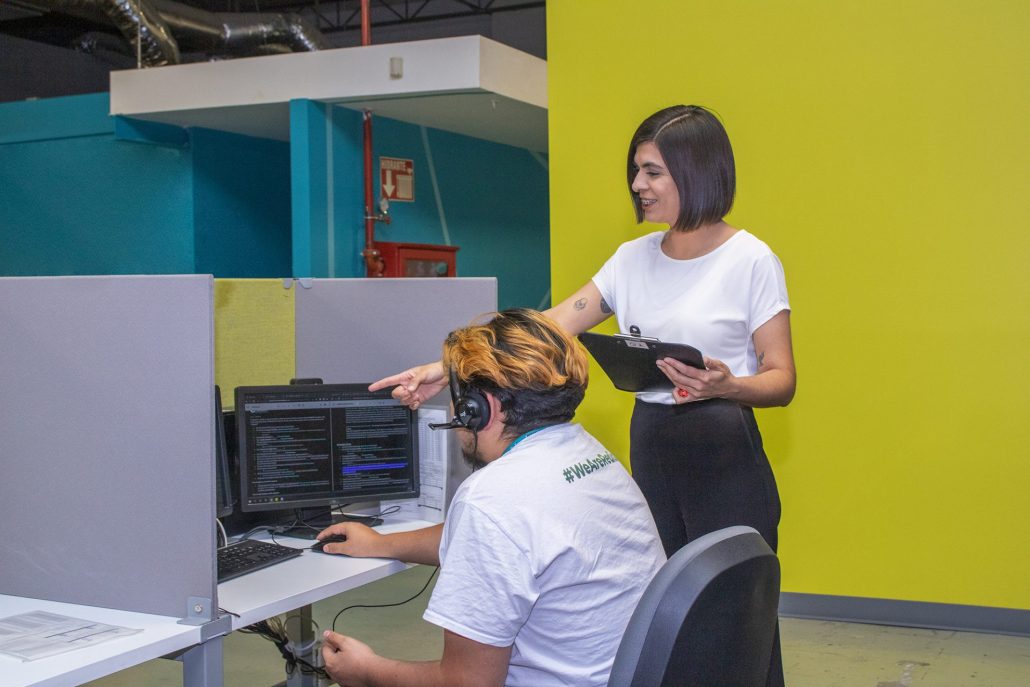
Call queuing is still one of the most effective ways to handle high call volume and reduce customer wait times. By placing callers in a queue, you can prioritize based on urgency, value tier, or intent, and handle calls in a structured order rather than first-come-first-served chaos.
Modern queuing goes further than older systems. Real-time wait-time estimates and automated callback options now let customers opt out of holding without losing their place, which is one of the most reliable ways to cut abandonment. Pair this with skills-based routing so that complex issues land with agents who can actually resolve them on the first try, rather than bouncing between transfers.
The principle from earlier versions of this strategy still holds: queuing alone is an organizational tool, not a complete solution. It needs to work alongside the staffing, training, and AI layers below to actually move the needle on customer experience.
Train your customer service team for high call volume periods
As AI absorbs more of the simple, repetitive call volume, the calls that reach your human agents during periods of high call volume are, on average, more complex. That raises the bar for training. Active listening, problem-solving under pressure, and deep product knowledge are no longer optional extras. They are the baseline expectation for any agent fielding calls that AI could not resolve on its own.
Your team should also be trained to work alongside AI tools rather than around them: trusting AI-suggested next steps when they are accurate, and knowing when to override them. We have covered the foundations of this in more detail in the importance of employee training in call centers, and that foundation matters more, not less, in an AI-augmented environment.
How to track call center metrics for human agents and AI tools
Monitoring call metrics such as call volume, average handle time, and abandonment rate helps you identify trends and staffing gaps before they become customer complaints. As a nearshore call center serving clients across the U.S., we track core fundamentals for every campaign:
- Bilingual communication quality in both English and Spanish.
- Average handle time, segmented by inquiry complexity.
- Abandonment rate, measured against time-to-abandon thresholds.
What is different in 2026 is that these metrics now need to be tracked at three levels: AI-only performance, human-only performance, and the blended total. Averaging everything together hides exactly where your operation is breaking down. If your blended CSAT looks healthy but your AI resolution rate is masking a high human escalation rate, you have a problem that a single blended number will never show you.
We build custom metrics alongside every client on top of these fundamentals, because the right KPI mix depends heavily on your industry and call mix. The advice from earlier versions of this guide still applies: be specific with the metrics you track, and make sure the team accountable for those metrics actually has the authority to act on what they reveal.
AI-assisted management strategies for high call volume peaks
This is the biggest shift since this guide was first written, and it deserves its own section. AI-assisted volume management now plays a direct role in how contact centers absorb high call volume during peak demand without proportionally scaling headcount.
In practice, this looks like a few specific capabilities working together:
Predictive routing and triage. AI can read intent signals from IVR selections, account history, or chat transcripts before a call ever reaches a human, routing high-complexity calls to senior agents and resolving simple ones (password resets, order status, appointment confirmations) without any agent involvement at all.
Real-time agent assist. Rather than replacing agents, AI tools increasingly support them mid-call: surfacing relevant account context, suggesting next-best actions, and drafting after-call summaries. Early data from platforms like Dialpad and CloudTalk suggests this can cut average handle time by 20-35% on assisted calls compared to fully manual handling.
Dynamic overflow management. During genuine volume spikes (a product recall, a billing error affecting thousands of customers, a seasonal peak) AI-powered routing can flex capacity by deflecting eligible calls to self-service or chat, smoothing the spike instead of letting it overwhelm the queue outright.
The caveat that matters: AI resolution rates currently range from 30-50% across most ticket types, with some categories exceeding 80% and others, particularly emotionally charged or highly regulated interactions, performing far worse. AI-assisted volume management is a force multiplier for handling high call volume, not a replacement for a well-trained human team. The contact centers getting the most value from it are the ones using AI to free up human agents for the calls that genuinely need a person, not the ones using it to justify cutting staff before resolution quality has been proven out.
Diversify your contact channels
Offering multiple contact channels (email, chat, social media, and self-service portals) continues to be one of the most effective ways to distribute inquiry volume and reduce pressure on your phone queue specifically. This also gives customers more control over how they reach you, which tends to improve satisfaction and loyalty independent of how quickly any single channel resolves their issue.
Self-service containment rates in 2026 range from 20% to 60% depending on automation maturity. Every inquiry your self-service or chat channel resolves is one fewer call your phone team has to absorb during a spike in high call volume, which makes channel diversification a direct lever on call volume itself, not just a parallel convenience.
In-house vs. outsourced: which handles high call volume better?
For many businesses, the real question is not which strategy to implement. It is who should be responsible for executing it once volume spikes hit. Here is how the two models typically compare on the factors that matter most during peak demand.
|
Factor |
In-House Team |
Outsourced Partner |
|
Scaling for seasonal spikes |
Limited by hiring/training lead time; often 4-8 weeks to onboard new agents |
Can flex headcount in days to weeks using an existing trained bench |
|
Cost during peak periods |
Fixed payroll cost regardless of volume, plus overtime during spikes |
Often usage-based or tiered pricing aligned to actual volume |
|
AI and routing technology |
Requires internal investment in tooling, integration, and maintenance |
Typically already deployed and tuned across multiple clients |
|
Bilingual coverage |
Dependent on local hiring market |
Built in by design at nearshore/offshore providers |
|
Continuity risk |
High. Institutional knowledge leaves when an agent or manager resigns |
Lower. Provider absorbs turnover and maintains coverage |
|
Speed to deploy for a new spike |
Weeks to months for meaningful headcount increase |
Days to a few weeks for an experienced partner |
|
Brand and product depth |
Strongest. Agents live inside the company daily |
Requires deliberate onboarding and ongoing alignment |
Neither column is universally right. A business with steady, predictable volume and a highly specialized product may get more value from a smaller in-house team with deep institutional knowledge. A business facing unpredictable seasonal peaks, after-hours demand, or rapid growth typically gets more value from an outsourced partner that can flex capacity without a multi-month hiring cycle.
Take the First Step Toward a Real Connection
Handling high call volume in 2026 requires the same operational discipline this guide has always emphasized: smart queuing, trained agents, disciplined metrics, and diversified channels, layered with a new requirement: a deliberate AI strategy that supports your team instead of merely deflecting calls away from it.
You can manage high call volume and deliver exceptional customer service by implementing structured queuing, training your team for the higher-complexity calls AI cannot resolve, monitoring human and AI performance separately, diversifying your contact channels, and choosing the staffing model (in-house, outsourced, or hybrid) that matches how predictable or volatile your demand actually is.
Looking for call center solutions that scale with your volume without a multi-month ramp-up? Talk to our team.