
RedialBPO
  • Services
    • Call Center Solutions
    • Contact Center Solutions
    • Core Services
      • Accounts Payable and Receivable
      • Back Office Support
      • Customer Service
      • Debt Collection
      • Insurance Verification
      • Order Taking Service
      • Sales Service Inbound and Outbound
      • Tech Support
      • Upselling and Cross-Selling
      • Voice AI Services
      • Workflow Automation Services
    • Additional Services
      • Appointment Setting
      • Data Processing
      • Email Request Services
      • Lead Generation
      • Live Chat Services
      • Transfer Service
    • BPO Services
    • BPO Nearshore Services
    • BPO Offshore Services
  • Industries
    • Automotive Services
    • Financial Services
    • Healthcare Services
    • Hospitality and Travel Services
    • IT Services
    • Logistics Services
    • Real Estate & Property Management
    • Retail Services
    • Telecom Services
    • Utility and Energy Services
  • Locations
    • Mexico
    • South Africa
    • Philippines
    • Follow-The-Sun Model
  • News & Events
    • Blog
    • Events
  • Company
    • About Us
    • Our Team
    • Media
    • Contact Us
  • Join Redial!
  • Get a Free Quote
  • Menu Menu
What is Customer Service in Logistics?
Redialers Insights

What is Customer Service in Logistics?

January 20, 2021/in CX and Services /by Redialers Insights

Logistics runs the modern economy, but ask any shipper what actually determines whether a buyer comes back, and the answer is rarely the truck, the warehouse or the software. It is the person on the other end of the phone or chat when something goes wrong, and the systems behind that person. That hidden layer is customer service in logistics, and it is where every promise the supply chain makes gets kept or broken. This piece explains what it covers, why it matters more than most operators realize, and how to think about scaling it.

Behind every successful logistics operation is an infrastructure of processes, people and systems working in sync, and customer service is the layer that translates all of it into a coherent buyer experience. Whether run in-house or delivered through specialized BPO services support, the way exceptions get handled, updates get shared, and questions get answered is what separates shippers that build repeat business from those that lose it to competitors with fewer excuses.

Show Table of Contents
Hide Table of Contents
  • What Customer Service in Logistics Actually Covers Today?
  • Why Logistics Customer Service Is a Strategic Growth Lever?
  • The Four Core Goals of Customer Service in Logistics Programs
    • Where Customer Service Touches Every Part of Logistics Operations
    • Supply Chain Management: Where Coordination Actually Happens
    • Shipping and Freight: Real-Time Visibility for Every Mode
    • Warehousing and Inventory: Bridging Storage to Shipment
    • Customs, Insurance and Cross-Border Documentation Guidance
  • In-House vs Outsourced: How to Decide for Your Operation
  • What to Look For in a Logistics Customer Service Partner?
    • Ready to scale logistics customer service without adding headcount?
  • Frequently Asked Questions About Customer Service in Logistics
    • 1. What is customer service in logistics?

What Customer Service in Logistics Actually Covers Today?

Customer service in logistics is the coordinated set of activities that keep shippers, carriers, warehouses and end customers informed and aligned throughout a shipment’s lifecycle. It covers order confirmations, tracking updates, exception handling, returns, and customs coordination, covering essentially every touchpoint between the moment a package enters the supply chain and the moment it arrives. Specialized logistics services BPO teams cover this end-to-end when in-house capacity cannot.

Unlike retail or SaaS customer service, logistics customer service is time-sensitive and multi-party. A single conversation can involve the shipper, the carrier, the warehouse, and sometimes customs, coordinated in real time. That coordination is what turns a raw supply chain into a customer-facing operation.

Why Logistics Customer Service Is a Strategic Growth Lever?

Companies that treat customer service as overhead miss the compounding effect it has on retention. A single missed shipment can cost more than a year of customer service investment. The customer who churned is gone forever, and the negative review they leave is permanent.

Independent research shows customer-enabled supply chains outperform on repurchase rates, yet a minority of supply chains actively design for customer enablement. To understand the scale of US logistics spend and its role in the wider economy, the annual State of Logistics Report puts the total in the trillions, a category where customer experience compounds directly into shareholder value.
Why Logistics Customer Service Is a Strategic Growth Lever?

The Four Core Goals of Customer Service in Logistics Programs

Stripped of jargon, logistics customer service exists to do four things:

  • Keep shipments on schedule and on promise: time compression is the entire premise of modern shipping; customer service is what enforces it in real time.
  • Build reliability through visibility: customers now expect to know where their package is at every step. How omnichannel support keeps supply chains transparent covers the operational shift this requires.
  • Protect margin through proactive resolution: a single call that catches a warehouse error before dispatch saves multiples of the call cost.
  • Create flexibility inside a rigid system: rules exist for a reason, but human judgment on exception handling is what keeps big customers from walking away.

Where Customer Service Touches Every Part of Logistics Operations

Logistics has more customer-facing surface area than most industries acknowledge. A shipment can generate a dozen customer touchpoints before it clears final delivery.

Supply Chain Management: Where Coordination Actually Happens

The supply chain has more moving parts than any single team can track manually. Customer service acts as the connective tissue, surfacing exceptions between procurement, warehousing, dispatch and delivery, and giving each stakeholder a single point of contact when something needs to be reconciled fast.

Shipping and Freight: Real-Time Visibility for Every Mode

Every mode, air, ground, sea, rail, has its own tracking granularity and its own failure modes. Customer service teams are the ones that translate carrier data into customer-readable status, escalate delays, and rebook shipments when routes fall apart. Integrating order taking service with dispatch reduces handoff errors and speeds up first-response time.

Real-time visibility is now the baseline expectation, not a differentiator. Shippers that cannot tell a customer where a package is in transit lose the customer regardless of how competitive their base pricing was.

Warehousing and Inventory: Bridging Storage to Shipment

Shipments do not always move immediately. Warehousing customer service manages the pause, confirming pickup times, coordinating with drivers, and preventing inventory from becoming stranded. Inventory reconciliation and returns processing are natural fits for a dedicated back-office support team that specializes in high-volume administrative logistics work.

Customs, Insurance and Cross-Border Documentation Guidance

International shipments introduce paperwork most shippers do not manage in-house. Customer service teams with cross-border expertise catch documentation errors before customs holds a shipment for days. For shippers moving across borders, why multilingual coverage matters for cross-border BPO is required reading. A customs officer explaining a discrepancy is not going to switch languages.
In-House vs Outsourced: How to Decide for Your Operation

The build-vs-buy decision on customer service in logistics comes down to volume predictability, geographic coverage and technology reach. Below is how the two models compare on the factors that actually move the P&L.

FactorIn-houseOutsourced (nearshore/offshore BPO)
Cost modelFixed (salaries, benefits, tech)Variable (per-seat / per-transaction)
Ramp time for peak seasons4-8 weeks to hire and train1-2 weeks with pre-vetted agents
Multilingual coverageRequires separate hires per languageBuilt-in bilingual/multilingual teams
24/7 coverageRequires 3 shiftsNative to follow-the-sun models
Technology investmentCapEx (CCaaS, WFM, QA tools)Included in vendor stack
Attrition riskConcentrated (small team)Distributed across vendor bench
Domain expertiseDeep (over time)Immediate (vendor sees many logistics ops)

What to Look For in a Logistics Customer Service Partner?

Not every BPO can run a logistics program. When evaluating a partner, ask about:

  • Logistics domain experience: has the vendor run programs for shippers, 3PLs, freight brokers or carriers before? Vague « we support many industries » answers are a red flag.
  • Multilingual capacity: cross-border shipping needs English + Spanish at minimum for North American operations; more for global.
  • Integration with your TMS/WMS: can they read from and write to your transportation and warehouse systems, or will their team ping yours for every lookup?
  • Peak-season staffing: logistics has predictable spikes (holidays, Cyber Week, tax season for logistics finance). Ask for prior surge case studies.
  • Real-time visibility tooling: their CCaaS platform should surface shipment status without agents having to alt-tab through 5 tools.
  • Compliance posture: PCI DSS for payments, SOC 2 for data. These are table stakes for enterprise shippers.
  • Onboarding timeline: most providers get a team live within 4-8 weeks.
  • Reporting cadence: weekly and monthly, tied to CX metrics like FCR, ASA, CSAT plus operational metrics like exception resolution time.

North American shippers increasingly prefer nearshore call center services for time-zone alignment, cultural fit and travel proximity, an advantage offshore providers cannot fully match.

Ready to scale logistics customer service without adding headcount?

Redial delivers logistics-specialized customer service through a nearshore-first model built for shippers, 3PLs and freight operators. If you are weighing in-house vs outsourced, or you need surge capacity for a peak season, we can walk you through what a program looks like for your volume and geography.

Contact us to discuss your logistics program  |  Get a free quote for your specific use case

Frequently Asked Questions About Customer Service in Logistics

1. What is customer service in logistics?

Customer service in logistics is the set of activities that keep shippers, carriers, warehouses and end customers informed and aligned throughout a shipment’s lifecycle. It covers order confirmations, tracking updates, exception handling, returns, and customs coordination, covering essentially every touchpoint between the moment a package enters the supply chain and the moment it arrives.

2. Why is customer service critical in logistics operations?

A single missed shipment can cost more than a year of customer service investment. Logistics is a low-margin, high-volume business where the customer experience during a delivery, not the product itself, often determines whether a buyer returns. Fast, accurate, empathetic service protects lifetime value in a way pricing cannot.

3. What tasks does a logistics customer service team handle?

Order intake, status updates, exception handling (delays, damage, misroutes), returns, warehousing coordination, freight tracking, customs paperwork support, and post-delivery follow-up. The most mature operations also handle multilingual customer support, real-time dispatcher escalations, and CX analytics tied to on-time delivery metrics.

4. Should logistics companies outsource customer service?

Yes, when volume is unpredictable, coverage needs cross time zones, or multilingual demand exceeds what an in-house team can staff cost-effectively. Outsourcing to a BPO with logistics domain expertise turns fixed cost into scalable capacity and gives access to CX technology that would take years to build internally.

5. How does customer service affect supply chain performance?

Directly. Customer service is where supply chain performance becomes visible to end customers. A well-run team catches problems before they escalate, cuts inquiry volume with proactive updates, and feeds ground-truth data back into planning. Underinvestment shows up as churn, negative reviews and higher cost per shipment resolved.
https://redialbpo.com/wp-content/uploads/2021/01/What-is-Customer-Service-in-Logistics.jpg 300 795 Redialers Insights https://redialbpo.com/wp-content/uploads/2026/04/rbpo_logo_color_large_black_600x209-300x105.png Redialers Insights2021-01-20 23:31:002026-08-14 11:02:26What is Customer Service in Logistics?
Nearshore call centers in Mexico: Benefits and model
Redialers Insights

Call Centers in Mexico The Real Value Of Nearshore Call Centers

January 15, 2021/in BPO /by Redialers Insights

US companies looking to scale customer service without sacrificing quality face a familiar three-way choice: build in-house, hire an offshore provider halfway around the world, or work with a nearshore partner. For most operations that touch English-speaking US customers, the third option , specifically nearshore call centers in Mexico , has quietly become the most defensible answer. This piece explains why, where the trade-offs actually sit, and how to evaluate a nearshore partner before signing anything.

The shift is not theoretical. Across verticals , from financial services and healthcare to retail call center services, technology support and travel , buyers report the same pattern: cost savings from deep offshore programs get eroded by rework, escalation costs, and customer-experience issues that never appeared on the initial spreadsheet. Nearshore closes that gap without giving up the cost advantage entirely. It is one of the few operational moves that improves both cost and quality at the same time.

Show Table of Contents
Hide Table of Contents
  • Why US companies are moving away from offshore call centers?
  • What makes nearshore call centers in Mexico different?
    • Cultural and business alignment with the US
    • Bilingual talent depth
    • Infrastructure and cost advantages
    • Time-zone and travel proximity
  • Offshore vs nearshore call centers: How they compare?
  • Industries where nearshore call centers in Mexico deliver the most
  • When nearshore call centers in Mexico make sense (and when they do not)
  • How to evaluate a nearshore call center partner in Mexico?
    • Ready to explore nearshore for your team?
  • Frequently Asked Questions About Nearshore Call Centers in Mexico
    • 1. What are nearshore call centers in Mexico?
    • 2. How much can you save with a call center in Mexico?
    • 3. What is the difference between nearshore and offshore call centers?
    • 4. Do call centers in Mexico have bilingual agents?
    • 5. How long does it take to set up a nearshore team in Mexico?

Why US companies are moving away from offshore call centers?

The offshore playbook that dominated the 2000s, India, the Philippines, and other Asian hubs handling US customer-service volumes , solved a cost problem but created a service one. Time-zone gaps meant issues raised at 4 PM in Chicago sat until the next morning. Cultural distance turned nuanced customer complaints into misread scripts. And attrition rates in mega-BPO cities pushed institutional knowledge out the door every 18 months.

The pattern is consistent: cost savings that looked good on the spreadsheet degraded once the operational reality set in. Escalations took longer, first-call resolution dropped, and customer satisfaction slipped in ways that only showed up months later in retention numbers and NPS scores.

None of that means offshore does not work, it means offshore has a shrinking sweet spot. For high-volume, low-complexity, time-insensitive work, offshore still makes sense. For everything else , anything with escalations, judgment calls, or customer emotion , the equation shifts.

What makes nearshore call centers in Mexico different?

Nearshore call centers in Mexico close the gap that offshore providers cannot. They combine three structural advantages: geographic proximity, cultural familiarity built over two centuries of cross-border relationship, and a talent pool that speaks fluent English at scale. Together those produce operations that behave more like a distributed US team than a traditional offshore contract.

Independent research now places Mexico consistently ranked among the top three global outsourcing destinations, a shift from the offshore-dominated landscape of a decade ago.

Cultural and business alignment with the US

Mexico’s northern border has integrated with the US economy for over 200 years. Business norms, customer expectations, holidays, sports references, brand culture , all of it maps closely enough that Mexican agents rarely need the ‘US cultural context’ training modules that offshore operations depend on. This is not a soft benefit. It shows up in first-call resolution rates, in the way agents handle ambiguous complaints, and in the tone of a de-escalation call.

Learn more about why Mexico is the right nearshore hub for US-facing operations. The cultural alignment also means faster onboarding for new hires , training focuses on the specific product, not on interpreting US customer behavior.

Bilingual talent depth

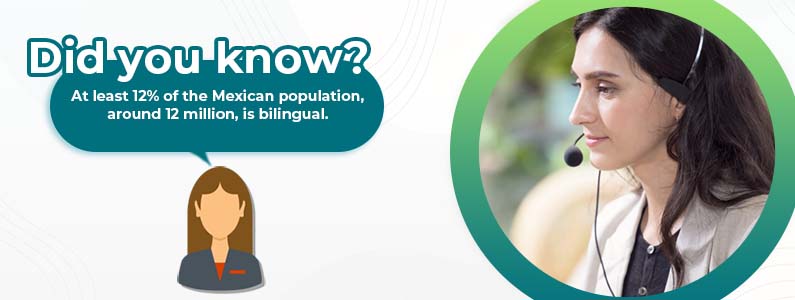
Border and metropolitan hubs consistently outperform the national average on independent English proficiency benchmarks for Mexican cities , a data point that matters more than aggregate country statistics for staffing a US-facing team. Tijuana, Ciudad Juárez, Monterrey and Mexico City each concentrate large populations of bilingual professionals shaped by decades of US-Mexico movement and cross-border employment.

This changes how quickly a nearshore operation can staff up. Rather than training language proficiency, providers hire it , which cuts ramp time and reduces the CX inconsistency that offshore programs struggle with. It also means better handling of accent-neutral communication, US idioms, and the informal register American consumers expect from customer service.

The depth of the talent pool also cushions against attrition. When a top agent leaves, the replacement bench is deep enough that program continuity is not disrupted , a stark contrast to single-city offshore operations where losing tenured staff can destabilize an entire program.

Infrastructure and cost advantages

The US-Mexico trade relationship remains the largest in North America, giving providers on the Mexican side of the border a regulatory framework and volume advantage no offshore competitor can match. Mexico is now the top source of US imports, and total bilateral trade exceeds $935 billion annually. That structural integration funds telecom, real estate and human-capital investments that directly benefit BPO operations.

On cost: nearshore call centers in Mexico typically deliver cost savings of 40-60% compared to onshore US operations, without the offshore trade-offs. Deep offshore can go further (50-70%) but the gap narrows once quality, attrition and rework costs are factored in. Tijuana and the broader Baja region concentrate much of this capacity , explained in the Baja California BPO advantage.

Beyond direct labor cost, nearshore Mexico programs also carry lower total-cost-of-ownership implications: reduced travel spend, less coordination overhead, and shorter contract cycles when scaling programs up or down.

Time-zone and travel proximity

Mexico’s operational zones span Pacific, Mountain and Central time , a full 8-hour workday overlap with the entire continental US. Same time zone, same day travel , issues get resolved before the day ends. An escalation at 3 PM ET gets a live human on the other end, not a queue for tomorrow’s shift. And if a US operations lead needs to visit the site, that’s a 3-5 hour flight , same-day travel, no jet lag.

The compounding effect matters: when leadership can visit a site quarterly instead of annually, program governance improves. When an escalated case gets resolved same-day instead of next-day, customer satisfaction moves. Small operational advantages stack into meaningful business outcomes over time.

Offshore vs nearshore call centers: How they compare?

The comparison below breaks down where each model actually differs. For a full breakdown of the nearshore vs offshore call center trade-offs, this deep-dive walks through the operational differences.

FactorOffshore (India, Philippines)Nearshore (Mexico)
Time zone overlap with US1-4 hours per day8+ hours (full workday)
Travel time from US16-24 hours flight3-5 hours flight
Cultural context with USRequires trainingNative familiarity via 200+ years of shared history
English proficiency (average)High variance by regionImproving , large bilingual talent pool in border cities
Turnover riskHistorically elevated in mega-BPOsLower attrition in tier-2 cities
Cost savings vs. US onshore50-70%40-60%
USMCA / trade frameworkNoneFull USMCA coverage
What makes nearshore call centers in Mexico different?

Industries where nearshore call centers in Mexico deliver the most

Not every industry gets the same return from nearshoring. Nearshore call centers in Mexico deliver the strongest results in verticals where customer trust, escalation quality, and same-day resolution drive lifetime value:

  • Financial services and BFSI: compliance-sensitive customer conversations that require judgment and calm under pressure , a nearshore agent trained on US regulatory norms outperforms a scripted offshore response.
  • Healthcare: insurance verification, patient scheduling and prior authorization , all functions where clarity beats speed, and where cultural context avoids costly errors.
  • Retail and e-commerce: seasonal peaks, returns handling, and loyalty-program support benefit from the ability to scale bilingual teams quickly and match US shopping calendars in real time.
  • Technology and SaaS: tier-1 and tier-2 support where clear English communication and empathy for non-technical users drive product retention.
  • Travel and hospitality: multi-currency, multi-time-zone bookings where 24/7 coverage without cultural misfires protects brand trust.
  • Logistics: cross-border coordination where shared time zones with US customers and carriers matter more than absolute cost.

If your business sits in one of these verticals, the nearshore economics are almost always favorable , the question stops being « should we? » and becomes « which partner? ».

When nearshore call centers in Mexico make sense (and when they do not)

Nearshore is not the right answer for every operation. It fits best when:

  • Customers are US-based and English-speaking
  • Interactions involve judgment, escalations, or emotional context (billing disputes, medical scheduling, high-value retention calls)
  • Time-zone alignment with US business hours matters
  • Cost pressure is real, but not so severe that quality can suffer
  • Compliance or data-residency constraints favor North America

For high-volume customer service outsourcing where quality drives retention, the nearshore option almost always outperforms deep offshore on lifetime value even if hourly rates are slightly higher.

Where nearshore is a worse fit: overnight batch processing, extreme low-cost high-volume queues where the CX bar is low, or Asia-Pacific customer bases where a Mexican operation adds no time-zone advantage.

The decision matrix comes down to three questions: does time-zone alignment matter, does cultural context affect quality, and is total-cost-of-ownership more important than headline hourly rate. If two of the three answers are yes, nearshore is likely the right choice.

How to evaluate a nearshore call center partner in Mexico?

Not every Mexican provider is equal. When evaluating a nearshore call center partner, ask about:

  • Location strategy: single-site or multi-site? Redundancy matters , a single-city provider carries continuity risk during regional disruptions.
  • Bilingual staffing model: how do they recruit, test and retain English-capable agents? Reject providers that cannot demonstrate a documented language assessment process.
  • Attrition rate: monthly and annual. Ask for the number, not a slogan. Anything above 8% monthly indicates operational stress that will show up in program quality.
  • Compliance posture: PCI DSS, HIPAA, SOC 2 , required for many US verticals. Certification is table stakes; ask for audit dates and scope.
  • Technology stack: CCaaS platform, workforce management, quality assurance, AI-assist capabilities. Providers still running legacy telephony without WFM tools will drag your operation.
  • Onboarding timeline: most providers get a team live within 4-8 weeks.
  • Cultural fit: shadow a call before signing. If the recorded interaction sounds like the offshore stereotype, that’s the answer.
  • Reporting cadence: weekly and monthly. Ask to see a sample report before signing , the depth and clarity of reporting predicts the depth and clarity of the operation.

The next step is choosing a specific provider , see how to choose the right outsourcing partner in Mexico.

Ready to explore nearshore for your team?

Redial delivers call center solutions across three global hubs , with our nearshore footprint concentrated in Mexico’s Baja region for US-facing programs. If you’re weighing nearshore against offshore or in-house, we can walk you through the operational math specific to your volume, complexity and compliance requirements.

Contact us to discuss your program requirements  |  Get a free quote for your specific use case

Free Quote Keep

Frequently Asked Questions About Nearshore Call Centers in Mexico

1. What are nearshore call centers in Mexico?

Nearshore call centers in Mexico are outsourced support teams based just across the US border, close enough to share time zones and business culture with American companies. They handle calls, chat, and back office tasks the way an offshore team would, but with far less distance and friction. The model is popular because it blends meaningful cost savings with easy, same day collaboration.

2. How much can you save with a call center in Mexico?

Savings vary by function and team size, but a favorable exchange rate and lower operating costs typically let companies run a Mexican team for a fraction of a comparable US build. Unlike some offshore setups, those savings tend to hold as you scale. The bigger win is often value rather than raw price: strong quality at a lower cost

3. What is the difference between nearshore and offshore call centers?

Nearshore means outsourcing to a nearby country in a similar time zone, like Mexico for US firms. Offshore means a distant region, often eight or more hours away. Nearshore usually wins on collaboration, time zone overlap, and cultural fit, while offshore can edge it out on the lowest per seat cost for high volume, script driven work.

4. Do call centers in Mexico have bilingual agents?

Yes. Mexican border cities have a large bilingual workforce fluent in both English and Spanish, which is a major reason US companies choose the region. That dual fluency is especially valuable for brands serving the growing US Hispanic market. It also means agents adapt quickly to American service expectations.

5. How long does it take to set up a nearshore team in Mexico?

With an established partner, a focused team can often be live within weeks rather than months, since the provider already has facilities, recruiting pipelines, and training in place. The exact timeline depends on team size, complexity, and compliance needs. A good partner will map the ramp with you before you commit.

https://redialbpo.com/wp-content/uploads/2021/01/Call-centers-in-Mexico-The-Real-Value-Of-Nearshore-Call-Centers.jpg 300 795 Redialers Insights https://redialbpo.com/wp-content/uploads/2026/04/rbpo_logo_color_large_black_600x209-300x105.png Redialers Insights2021-01-15 03:35:002026-08-13 23:29:56Call Centers in Mexico The Real Value Of Nearshore Call Centers
How to Choose the Outsourcing Call Center Partner in Mexico
Redialers Insights

How to Choose the Best Outsourcing Call Center Partner in Mexico

January 4, 2021/in CX and Services /by Redialers Insights

Most companies researching outsourcing call center to Mexico start by comparing hourly rates. That is the wrong first move. Rate tells you what a provider charges. It tells you nothing about whether your customers hang up satisfied, and that is the number that actually shows up in your revenue.

The case for outsourcing call center to Mexico is strong, and the reasons are covered below. But the country is not the decision. The partner is the decision. Two providers in the same Tijuana office park can deliver completely different outcomes. This guide covers why the move works, then gives you a seven-factor checklist for choosing who you actually sign with.

Show Table of Contents
Hide Table of Contents
  • Why Outsourcing Call Center to Mexico Works
  • 7 Factors to Check Before Outsourcing Call Center to Mexico
    • 1. Infrastructure: What the Operation Actually Runs On
    • 2. Campaign and Industry Experience
    • 3. Onboarding: The Clearest Early Signal You Will Get
    • 4. Language and Cultural Fit
    • 5. Support Staff and the Bench Behind Them
    • 6. Does the Provider Actually Want to Be a Partner?
    • 7. Service Fit: Does the Catalog Match Where You Are Going?
  • The 7-Factor Scorecard for Outsourcing Call Center to Mexico
  • Is Outsourcing Call Center to Mexico Right for Your Business?
  • Let's Talk About Your Call Center Strategy
  • Frequently Asked Questions About Outsourcing Call Center to Mexico
    • 1. What are the benefits of outsourcing call center to Mexico?
    • 2. What should I look for in an outsourcing call center partner in Mexico?
    • 3. How do I start outsourcing call center to Mexico?
    • 4. Is outsourcing call center to Mexico cheaper than the Philippines or India?
    • 5. Should I outsource multiple processes to the same partner?

Why Outsourcing Call Center to Mexico Works

Three advantages do most of the work behind outsourcing call center to Mexico, and only one of them is cost.

  • Time zone alignment. Agents in Mexico work your hours. An escalation raised at 2pm gets resolved at 3pm, not tomorrow morning. Offshore support buys you a lower rate and charges you a full business day for every correction.
  • Cultural fluency. The US and Mexico share centuries of overlapping commerce, language, and culture. Agents in border cities carry the accents, idioms, and references your customers already recognize.
  • Depth of talent. Mexico has a mature call center industry, which means a real pool of trained agents, supervisors, and QA staff rather than a building full of new hires.

This is part of why more US companies are relocating operations closer to home rather than defaulting to farther offshore destinations. The scale is not marginal: in an analysis based on trade data, the Inter-American Development Bank put the nearshoring opportunity across Latin America at roughly 78 billion dollars a year in additional exports, with about 14 billion of that in services rather than goods, and Mexico positioned to capture the largest single share.

If you are still weighing the country itself rather than the partner, how nearshore and offshore call centers compare is the better starting point. If Mexico is already decided, the rest of this article is the part that matters.

How to Choose the Best Outsourcing Call Center Partner in Mexico

7 Factors to Check Before Outsourcing Call Center to Mexico

Get most of these right and the partnership quietly works. Get one badly wrong and no discount cover the cost of unwinding it.

1. Infrastructure: What the Operation Actually Runs On

Infrastructure is where outsourcing call center to Mexico either scales or stalls. It splits into two layers, and a provider can be strong in one and thin in the other.

  • Regional infrastructure is the city around the operation: power reliability, connectivity, transit for agents, and physical room to expand into.
  • Business infrastructure is what the center itself runs on: workstations, redundant power and internet, physical and data security, and the software stack agents live in all day.

Mexico’s capacity here has kept up with demand. Mexico’s expanding industrial infrastructure is projected to reach 477 industrial parks across 28 states in 2026, with over 100 more under construction, which has made border and near-border cities steadily more viable for operations that need reliable facilities and room to grow into.

A provider with real infrastructure depth will not just absorb today’s volume, it will absorb next year’s without a visible dip in service. That is the difference between a partner you scale with and one you outgrow.

2. Campaign and Industry Experience

Experience is not one thing. Separate the layers before you evaluate it.

  • Role experience: customer support, sales, technical support, billing, collections.
  • Vertical experience: logistics, finance, ecommerce, healthcare. Each carries its own escalation patterns and seasonal rhythms.
  • Org-wide experience, from frontline agents up through supervisors and QA.
  • Process maturity. A provider who has run comparable campaigns already knows where your volume will spike and where quality usually slips.

The fastest way to test these costs nothing. A provider with real vertical depth asks sharper questions during the sales conversation than one reciting a generic capabilities pitch. Listen for who is interviewing whom.

3. Onboarding: The Clearest Early Signal You Will Get

How a provider runs onboarding tells you how they will run everything else. Providers with a tested methodology move faster because the staff, tools, and training material already exist before your contract is signed, rather than being assembled around your account after the fact.

  • Experienced partners follow a proven, repeatable ramp-up process instead of improvising one per client.
  • Staff and resources should be ready when terms are agreed, not recruited afterward.
  • Good onboarding surfaces gaps early, while there is still time to fix them, instead of letting them harden into recurring complaints.
  • Shared time zones mean a correction goes live the same day rather than costing a full cycle of back and forth.

That last point is where nearshore quietly earns its keep, and it is a large part of why Tijuana has become a nearshore hub for US companies.

Outsourcing call center to Mexico: Onboarding process

4. Language and Cultural Fit

Teams that succeed at outsourcing call center to Mexico usually credit cultural fit before they credit cost. It is the factor buyers underestimate most, because it never appears on a rate card. It appears in the transcript.

Agents in border cities like Tijuana often carry the accents, idioms, and references a US customer already recognizes. That shortens the distance between an answer that is technically correct and one that sounds like it came from someone who actually understands the caller. Proximity buys logistics. It also buys cultural fluency, and the second one is far harder to train from scratch.

For businesses serving Spanish-speaking customers too, bilingual coverage stops being a nice-to-have and becomes the whole reason a Mexico-based partner outperforms a cheaper alternative eight time zones away. Redial builds its customer service programs on exactly this.

5. Support Staff and the Bench Behind Them

The people layer is easy to underweight, because it is invisible in a proposal deck. It should not be.

  • A deep talent pool means faster staffing when a program has to scale on short notice.
  • Training periods shorten when new hires already understand call center fundamentals before they ever touch your brand.
  • Agents must be retrained continuously as your product, pricing, or policies change, not trained once at launch and left to drift.
  • Quality holds from the first call to the thousandth only when there is a real bench behind the frontline. Turnover is inevitable in this industry. Depth is what absorbs it.

For multichannel or higher-volume programs, this is also where a provider’s contact center solutions capability matters, since running voice, chat, and email well requires supervisory structure, not just headcount.

6. Does the Provider Actually Want to Be a Partner?

Companies weighing outsourcing call center to Mexico almost never ask this question, and it is the one that separates a partner from a vendor. Capability can be verified on a site tour. Posture only reveals itself in how a provider engages before there is any contract to protect.

Watch for four things:

  • Interest in your business, not just your volume. A provider with real industry experience understands what you do in the first conversation and does not need your category explained twice.
  • Understanding of your culture and vision. A partner who knows your objectives, and how you want customers treated, makes better calls in the moments no script covers. Those moments are most of the job.
  • A stake in how your brand looks. Those agents represent you, not them. A partner who treats that as their responsibility, rather than something for you to police, produces a measurably different quality of interaction.
  • Flexibility and headroom. If your business doubles, the partner has to double with it without renegotiating the relationship from zero.

7. Service Fit: Does the Catalog Match Where You Are Going?

The last factor pays off in year two, not month one. Do not evaluate a provider only against what you need today.

  • Confirm their current offerings cover your existing line of business. A mismatch here is a hard blocker, not a negotiation.
  • Then look at everything else they run. If the same partner can take on processes you may want to move later, you avoid onboarding a second vendor, splitting your line of communication, and coordinating two contracts through every critical change.
  • Vendor sprawl quietly eats the savings that motivated outsourcing in the first place. Consolidating with one capable partner protects them.
  • Look for adjacent services worth testing, such as lead generation, which can open a market segment you are not currently reaching.

The 7-Factor Scorecard for Outsourcing Call Center to Mexico

Print this, fill in a column per provider, and the shortlist tends to sort itself out.

FactorWhat Good Looks LikeQuestion to Ask
InfrastructureRedundant power and connectivity, secure facilities, room to expandWhat is your uptime history and backup setup?
ExperienceProven track record inside your specific verticalWalk me through a client in my industry
OnboardingDocumented, tested ramp-up with a clear timelineHow long until a new program is live?
Language and CultureEnglish fluency with US business context, bilingual where neededHow do you measure cultural fluency after launch?
Support StaffDeep bench of agents, supervisors, and QA, with ongoing retrainingAgent-to-supervisor ratio? Average tenure?
Partnership PostureUnderstands your business, flexible, invested in your brandWhat do you already know about my industry?
Service FitCatalog covers today’s needs and next year’s expansionWhat do clients like me add in year two?

Is Outsourcing Call Center to Mexico Right for Your Business?

For most US companies handling meaningful support or sales volume, yes. But the honest answer depends on what you are optimizing for.

If your priority is…Mexico is…Because
Same-day resolution and tight coordinationThe strongest fitShared time zones remove the one-day lag that offshore support builds into every correction
Bilingual English and Spanish coverageThe strongest fitBorder-city talent pools are natively bilingual with US cultural context
The absolute lowest hourly rateNot the cheapest optionOffshore rates are lower. The gap tends to reappear as turnover, escalations, and churn
A vendor you never speak to againProbably overkillMexico earns its premium through proximity and collaboration. If you will not use them, you are paying for them anyway

Redial BPO built its operation around call center services based in Mexico for the reasons above rather than in spite of them, and has watched the real value of nearshore call centers in Mexico play out across ecommerce, finance, and logistics accounts. Why companies choose Mexico covers the country-level case in more depth.

Is Outsourcing Call Center to Mexico Right for Your Business?

Let’s Talk About Your Call Center Strategy

The seven factors above are the right starting checklist, but no two businesses weigh them the same way. A high-volume ecommerce operation prioritizes elastic scale and seasonal flexibility. A financial services team prioritizes security posture and agent tenure. A healthcare practice cares about accuracy above all.

Contact us to talk through which of the seven actually matter for your operation, or get a free quote to see what outsourcing call center to Mexico looks like at your volume.

Outsourcing call center to Mexico Quote

Frequently Asked Questions About Outsourcing Call Center to Mexico

1. What are the benefits of outsourcing call center to Mexico?

Three reasons: your agents work your hours, so escalations resolve the same day instead of the next one; border-city talent pools are natively bilingual and carry US cultural context; and Mexico has a mature call center industry with a deep bench of trained agents and supervisors. Cost matters, but it is rarely the deciding factor.

2. What should I look for in an outsourcing call center partner in Mexico?

Seven factors: infrastructure, industry experience, onboarding process, language and cultural fit, support staff depth, whether the provider behaves like a partner rather than a vendor, and whether their service catalog covers where your business is heading. A strong provider performs across all seven, not just the two that are easiest to demo.

3. How do I start outsourcing call center to Mexico?

Shortlist providers against the seven factors above, then run each one through the onboarding question. Experienced partners can bring a new program live within a few weeks, because the staff, infrastructure, and training process already exist before the contract is signed. Timelines stretch when a business needs heavy system integration or a highly custom setup.

4. Is outsourcing call center to Mexico cheaper than the Philippines or India?

Usually not on rate alone. Offshore hourly rates tend to be lower. The comparison changes when you count the cost of a full business day lost to every correction, higher escalation rates, and the customer churn that follows a support experience that feels distant. Mexico competes on total cost, not on sticker price.

5. Should I outsource multiple processes to the same partner?

Usually yes, if the partner is capable across them. One provider means one line of communication, one contract, and faster rollout when something changes. Splitting processes across vendors creates coordination overhead that quietly erodes the savings that motivated outsourcing in the first place.

    •  
https://redialbpo.com/wp-content/uploads/2021/01/How-to-choose-the-best-Outsourcing-Call-Center-partner-in-Mexico.jpg 300 795 Redialers Insights https://redialbpo.com/wp-content/uploads/2026/04/rbpo_logo_color_large_black_600x209-300x105.png Redialers Insights2021-01-04 19:20:002026-07-16 15:22:37How to Choose the Best Outsourcing Call Center Partner in Mexico

Search our CX Blog

Recent Posts

  • Eligibility verification denialsWhy Claim Denials Spike When Eligibility Checks Happen Too LateAugust 7, 2026 - 2:48 pm
  • Promotional banner for the Dykem a 2C26 13th Annual DSO Conference: July 15–17, 2026 in Denver, CO with calendar and location icons and the Redial logo.Redial BPO Heads to the Dykema DSO Conference 2026 — Denver, July 15–17July 2, 2026 - 10:09 am
  • CCW Las Vegas 22-25 June, 2026 - Redial BPO - Official SponsorRedial BPO Is an Official Sponsor of CCW Las Vegas 2026 — and We’re Bringing Something BigMay 19, 2026 - 12:59 pm
  • Banner for a report: The State of Insurance Verification 2026; subtitle notes AI, staffing pressure, and denials; stethoscope on the left with Redial logo.Prior Authorization Outsourcing: How Healthcare Practices Are Cutting Denials and Reclaiming Clinical TimeApril 24, 2026 - 11:17 am
  • Auto Finance Summit East 2026Redial BPO attending Auto Finance Summit East 2026April 13, 2026 - 1:02 pm

Categories

  • Awards
  • BPO
  • Business Process Outsourcing
  • Call Center
  • Collections service
  • Customer Service
  • Customer Support
  • CX and Services
  • Events
  • Healthcare
  • Industries
  • Insurance Verification
  • Live Chat
  • News
  • Omnichannel
  • Redial Culture

PCI Logo Redial BPO

Nearshore & offshore call-center teams that protect your brand — PCI DSS and HIPAA-compliant, and ready to scale with your volume.

Services

  • Customer Service
  • Technical Support
  • Inbound & Outbound Sales
  • Debt Collection
  • Back-Office Support
  • Lead Generation
  • Live Chat & Email
  • All Services →

Industries

  • Financial Services
  • Healthcare
  • Retail & E-commerce
  • Technology & SaaS
  • Telecommunications
  • Travel & Hospitality
  • Logistics
  • All Industries →

Locations

  • Mexico
  • South Africa
  • Philippines
  • All Locations →

Company

  • Leadership
  • Blog
  • Contact Us
  • Join Redial!
  • Get a Quote
Redial BPO Logo

© 2026 Redial. All Rights Reserved.

  • Privacy Policy
  • Terms of Use

Scroll to top