
Call Centers in Mexico The Real Value Of Nearshore Call Centers
US companies looking to scale customer service without sacrificing quality face a familiar three-way choice: build in-house, hire an offshore provider halfway around the world, or work with a nearshore partner. For most operations that touch English-speaking US customers, the third option , specifically nearshore call centers in Mexico , has quietly become the most defensible answer. This piece explains why, where the trade-offs actually sit, and how to evaluate a nearshore partner before signing anything.
The shift is not theoretical. Across verticals , from financial services and healthcare to retail call center services, technology support and travel , buyers report the same pattern: cost savings from deep offshore programs get eroded by rework, escalation costs, and customer-experience issues that never appeared on the initial spreadsheet. Nearshore closes that gap without giving up the cost advantage entirely. It is one of the few operational moves that improves both cost and quality at the same time.
- Why US companies are moving away from offshore call centers?
- What makes nearshore call centers in Mexico different?
- Offshore vs nearshore call centers: How they compare?
- Industries where nearshore call centers in Mexico deliver the most
- When nearshore call centers in Mexico make sense (and when they do not)
- How to evaluate a nearshore call center partner in Mexico?
- Frequently Asked Questions About Nearshore Call Centers in Mexico
Why US companies are moving away from offshore call centers?
The offshore playbook that dominated the 2000s, India, the Philippines, and other Asian hubs handling US customer-service volumes , solved a cost problem but created a service one. Time-zone gaps meant issues raised at 4 PM in Chicago sat until the next morning. Cultural distance turned nuanced customer complaints into misread scripts. And attrition rates in mega-BPO cities pushed institutional knowledge out the door every 18 months.
The pattern is consistent: cost savings that looked good on the spreadsheet degraded once the operational reality set in. Escalations took longer, first-call resolution dropped, and customer satisfaction slipped in ways that only showed up months later in retention numbers and NPS scores.
None of that means offshore does not work, it means offshore has a shrinking sweet spot. For high-volume, low-complexity, time-insensitive work, offshore still makes sense. For everything else , anything with escalations, judgment calls, or customer emotion , the equation shifts.
What makes nearshore call centers in Mexico different?
Nearshore call centers in Mexico close the gap that offshore providers cannot. They combine three structural advantages: geographic proximity, cultural familiarity built over two centuries of cross-border relationship, and a talent pool that speaks fluent English at scale. Together those produce operations that behave more like a distributed US team than a traditional offshore contract.
Independent research now places Mexico consistently ranked among the top three global outsourcing destinations, a shift from the offshore-dominated landscape of a decade ago.
Cultural and business alignment with the US
Mexico’s northern border has integrated with the US economy for over 200 years. Business norms, customer expectations, holidays, sports references, brand culture , all of it maps closely enough that Mexican agents rarely need the ‘US cultural context’ training modules that offshore operations depend on. This is not a soft benefit. It shows up in first-call resolution rates, in the way agents handle ambiguous complaints, and in the tone of a de-escalation call.
Learn more about why Mexico is the right nearshore hub for US-facing operations. The cultural alignment also means faster onboarding for new hires , training focuses on the specific product, not on interpreting US customer behavior.
Bilingual talent depth
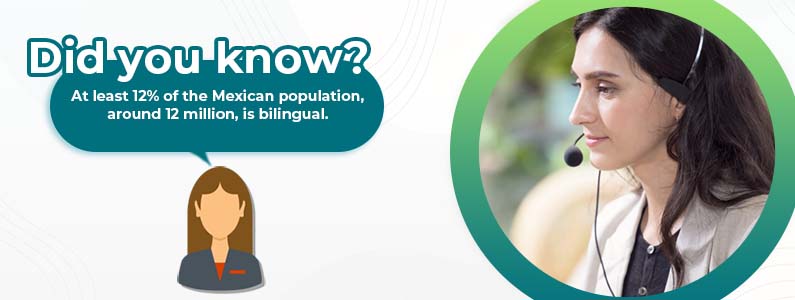
Border and metropolitan hubs consistently outperform the national average on independent English proficiency benchmarks for Mexican cities , a data point that matters more than aggregate country statistics for staffing a US-facing team. Tijuana, Ciudad Juárez, Monterrey and Mexico City each concentrate large populations of bilingual professionals shaped by decades of US-Mexico movement and cross-border employment.
This changes how quickly a nearshore operation can staff up. Rather than training language proficiency, providers hire it , which cuts ramp time and reduces the CX inconsistency that offshore programs struggle with. It also means better handling of accent-neutral communication, US idioms, and the informal register American consumers expect from customer service.
The depth of the talent pool also cushions against attrition. When a top agent leaves, the replacement bench is deep enough that program continuity is not disrupted , a stark contrast to single-city offshore operations where losing tenured staff can destabilize an entire program.
Infrastructure and cost advantages
The US-Mexico trade relationship remains the largest in North America, giving providers on the Mexican side of the border a regulatory framework and volume advantage no offshore competitor can match. Mexico is now the top source of US imports, and total bilateral trade exceeds $935 billion annually. That structural integration funds telecom, real estate and human-capital investments that directly benefit BPO operations.
On cost: nearshore call centers in Mexico typically deliver cost savings of 40-60% compared to onshore US operations, without the offshore trade-offs. Deep offshore can go further (50-70%) but the gap narrows once quality, attrition and rework costs are factored in. Tijuana and the broader Baja region concentrate much of this capacity , explained in the Baja California BPO advantage.
Beyond direct labor cost, nearshore Mexico programs also carry lower total-cost-of-ownership implications: reduced travel spend, less coordination overhead, and shorter contract cycles when scaling programs up or down.
Time-zone and travel proximity
Mexico’s operational zones span Pacific, Mountain and Central time , a full 8-hour workday overlap with the entire continental US. Same time zone, same day travel , issues get resolved before the day ends. An escalation at 3 PM ET gets a live human on the other end, not a queue for tomorrow’s shift. And if a US operations lead needs to visit the site, that’s a 3-5 hour flight , same-day travel, no jet lag.
The compounding effect matters: when leadership can visit a site quarterly instead of annually, program governance improves. When an escalated case gets resolved same-day instead of next-day, customer satisfaction moves. Small operational advantages stack into meaningful business outcomes over time.
Offshore vs nearshore call centers: How they compare?
The comparison below breaks down where each model actually differs. For a full breakdown of the nearshore vs offshore call center trade-offs, this deep-dive walks through the operational differences.
| Factor | Offshore (India, Philippines) | Nearshore (Mexico) |
| Time zone overlap with US | 1-4 hours per day | 8+ hours (full workday) |
| Travel time from US | 16-24 hours flight | 3-5 hours flight |
| Cultural context with US | Requires training | Native familiarity via 200+ years of shared history |
| English proficiency (average) | High variance by region | Improving , large bilingual talent pool in border cities |
| Turnover risk | Historically elevated in mega-BPOs | Lower attrition in tier-2 cities |
| Cost savings vs. US onshore | 50-70% | 40-60% |
| USMCA / trade framework | None | Full USMCA coverage |
Industries where nearshore call centers in Mexico deliver the most
Not every industry gets the same return from nearshoring. Nearshore call centers in Mexico deliver the strongest results in verticals where customer trust, escalation quality, and same-day resolution drive lifetime value:
- Financial services and BFSI: compliance-sensitive customer conversations that require judgment and calm under pressure , a nearshore agent trained on US regulatory norms outperforms a scripted offshore response.
- Healthcare: insurance verification, patient scheduling and prior authorization , all functions where clarity beats speed, and where cultural context avoids costly errors.
- Retail and e-commerce: seasonal peaks, returns handling, and loyalty-program support benefit from the ability to scale bilingual teams quickly and match US shopping calendars in real time.
- Technology and SaaS: tier-1 and tier-2 support where clear English communication and empathy for non-technical users drive product retention.
- Travel and hospitality: multi-currency, multi-time-zone bookings where 24/7 coverage without cultural misfires protects brand trust.
- Logistics: cross-border coordination where shared time zones with US customers and carriers matter more than absolute cost.
If your business sits in one of these verticals, the nearshore economics are almost always favorable , the question stops being « should we? » and becomes « which partner? ».
When nearshore call centers in Mexico make sense (and when they do not)
Nearshore is not the right answer for every operation. It fits best when:
- Customers are US-based and English-speaking
- Interactions involve judgment, escalations, or emotional context (billing disputes, medical scheduling, high-value retention calls)
- Time-zone alignment with US business hours matters
- Cost pressure is real, but not so severe that quality can suffer
- Compliance or data-residency constraints favor North America
For high-volume customer service outsourcing where quality drives retention, the nearshore option almost always outperforms deep offshore on lifetime value even if hourly rates are slightly higher.
Where nearshore is a worse fit: overnight batch processing, extreme low-cost high-volume queues where the CX bar is low, or Asia-Pacific customer bases where a Mexican operation adds no time-zone advantage.
The decision matrix comes down to three questions: does time-zone alignment matter, does cultural context affect quality, and is total-cost-of-ownership more important than headline hourly rate. If two of the three answers are yes, nearshore is likely the right choice.
How to evaluate a nearshore call center partner in Mexico?
Not every Mexican provider is equal. When evaluating a nearshore call center partner, ask about:
- Location strategy: single-site or multi-site? Redundancy matters , a single-city provider carries continuity risk during regional disruptions.
- Bilingual staffing model: how do they recruit, test and retain English-capable agents? Reject providers that cannot demonstrate a documented language assessment process.
- Attrition rate: monthly and annual. Ask for the number, not a slogan. Anything above 8% monthly indicates operational stress that will show up in program quality.
- Compliance posture: PCI DSS, HIPAA, SOC 2 , required for many US verticals. Certification is table stakes; ask for audit dates and scope.
- Technology stack: CCaaS platform, workforce management, quality assurance, AI-assist capabilities. Providers still running legacy telephony without WFM tools will drag your operation.
- Onboarding timeline: most providers get a team live within 4-8 weeks.
- Cultural fit: shadow a call before signing. If the recorded interaction sounds like the offshore stereotype, that’s the answer.
- Reporting cadence: weekly and monthly. Ask to see a sample report before signing , the depth and clarity of reporting predicts the depth and clarity of the operation.
The next step is choosing a specific provider , see how to choose the right outsourcing partner in Mexico.
Ready to explore nearshore for your team?
Redial delivers call center solutions across three global hubs , with our nearshore footprint concentrated in Mexico’s Baja region for US-facing programs. If you’re weighing nearshore against offshore or in-house, we can walk you through the operational math specific to your volume, complexity and compliance requirements.
Contact us to discuss your program requirements | Get a free quote for your specific use case

Frequently Asked Questions About Nearshore Call Centers in Mexico
1. What are nearshore call centers in Mexico?
Nearshore call centers in Mexico are outsourced support teams based just across the US border, close enough to share time zones and business culture with American companies. They handle calls, chat, and back office tasks the way an offshore team would, but with far less distance and friction. The model is popular because it blends meaningful cost savings with easy, same day collaboration.
2. How much can you save with a call center in Mexico?
Savings vary by function and team size, but a favorable exchange rate and lower operating costs typically let companies run a Mexican team for a fraction of a comparable US build. Unlike some offshore setups, those savings tend to hold as you scale. The bigger win is often value rather than raw price: strong quality at a lower cost
3. What is the difference between nearshore and offshore call centers?
Nearshore means outsourcing to a nearby country in a similar time zone, like Mexico for US firms. Offshore means a distant region, often eight or more hours away. Nearshore usually wins on collaboration, time zone overlap, and cultural fit, while offshore can edge it out on the lowest per seat cost for high volume, script driven work.
4. Do call centers in Mexico have bilingual agents?
Yes. Mexican border cities have a large bilingual workforce fluent in both English and Spanish, which is a major reason US companies choose the region. That dual fluency is especially valuable for brands serving the growing US Hispanic market. It also means agents adapt quickly to American service expectations.
5. How long does it take to set up a nearshore team in Mexico?
With an established partner, a focused team can often be live within weeks rather than months, since the provider already has facilities, recruiting pipelines, and training in place. The exact timeline depends on team size, complexity, and compliance needs. A good partner will map the ramp with you before you commit.

Redialers Insights is Redial BPO’s editorial voice, sharing practical perspectives on business performance, operational excellence, customer experience, and company culture.
We share real-world learnings and timely updates to offer prospective clients a clear, trustworthy view of how Redial BPO supports brands, their customers and internal teams.