
RedialBPO
  • Services
    • Call Center Solutions
    • Contact Center Solutions
    • Core Services
      • Accounts Payable and Receivable
      • Back Office Support
      • Customer Service
      • Debt Collection
      • Insurance Verification
      • Order Taking Service
      • Sales Service Inbound and Outbound
      • Tech Support
      • Upselling and Cross-Selling
      • Voice AI Services
      • Workflow Automation Services
    • Additional Services
      • Appointment Setting
      • Data Processing
      • Email Request Services
      • Lead Generation
      • Live Chat Services
      • Transfer Service
    • BPO Services
    • BPO Nearshore Services
    • BPO Offshore Services
  • Industries
    • Automotive Services
    • Financial Services
    • Healthcare Services
    • Hospitality and Travel Services
    • IT Services
    • Logistics Services
    • Real Estate & Property Management
    • Retail & eCommerce Services
    • Telecom Services
    • Utility and Energy Services
  • Locations
    • Mexico
    • South Africa
    • Philippines
    • Follow-The-Sun Model
  • News & Events
    • Blog
    • Events
  • Company
    • About Us
    • Our Team
    • Media
    • Contact Us
  • Join Redial!
  • Get a Free Quote
  • Menu Menu
post-holiday returns surge
Mary Pacheco

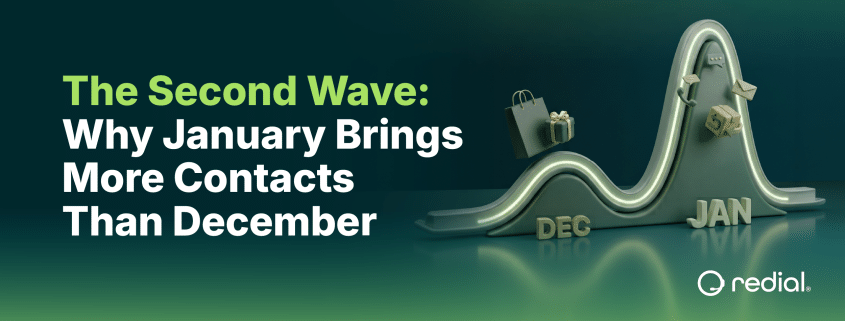
The Second Wave: Why January Brings More Contacts Than December

October 16, 2026/in Contact Center /by Mary Pacheco

Every peak plan is built around December. Staffing ramps up for it, forecasts are argued over it, and on the 26th most teams exhale. That is the mistake. The post-holiday returns surge begins the same day, and it does not look like the wave that came before it. December contacts are mostly people asking where a parcel is. January contacts are people sending parcels back, chasing refunds and filing claims for deliveries that arrived late or damaged. They take longer, touch more systems and are more likely to come back a second time. For a carrier, a 3PL or a retailer’s fulfillment desk, the second wave is smaller in headlines and heavier in work, and it lands just as seasonal capacity is being released.

December Is Volume. January Is Work.

The timing is tight. Adobe’s data on the 2025 holiday season showed returns rising 4.7% in the six days after Christmas, and found that one in every seven returns of the entire season happened between December 26 and December 31.

The base it sits on is large. According to the National Retail Federation’s 2025 returns landscape, an estimated 19.3% of online sales were expected to be returned in 2025. Roughly one online order in five comes back, and a disproportionate share of those start their journey in the week most support teams are standing down.

For the logistics side, each return is not one event. It is a label, a pickup or drop-off, a scan, a receipt at the warehouse, an inspection and a refund trigger, and the customer may contact someone at any of those points. That is the case for planning for the five weeks after Christmas as a season of its own.

The staffing calendar runs the other way. Seasonal contracts are typically written to the shipping peak, so the most experienced temporary agents leave in the same week the hardest contacts begin. The team that handled December at full strength meets January at reduced strength, with permanent staff also taking the leave they postponed.

There is a difference in mood as well. A December caller is waiting for something they want. A January caller is disappointed with something they received, or still waiting for money they are owed. The delay that was tolerated before Christmas is not tolerated after it.

The monthly picture points the same way. Salesforce figures reported by Digital Commerce 360 in late January 2026 put returns at 12.2% of global online orders in the first two weeks of the year, and noted that January remains the month with the largest number of returns overall. No public dataset counts service contacts by month, but every one of those returns is a reason to make one.

How the Contact Mix Shifts

The table sets each contact type against its direction in January and the measured figure that explains it. Shares of a queue vary too much from one business to the next to publish as an average, so the last column uses what has actually been counted.

Contact typeIn JanuaryEffort per contactThe measured signal behind it
Order status and trackingFalls sharplyLow. Often resolved by self-serviceHoliday orders are placed by December 31, the end of the season as Adobe measures it
Pre-delivery changes (address, date, hold)FallsLow to mediumSame cause: few new shipments are in transit
Return initiation and labelsRises sharplyMediumOne in seven of the season’s returns fell on December 26 to 31 (Adobe); January still has the largest number of returns overall (Salesforce)
Refund statusRises sharplyMedium. Frequently a repeat contact12.2% of global online orders were returned in January 1 to 14, 2026 (Salesforce), each with a refund pending
Exchanges and replacementsRisesHigh. Two shipments, one conversation19.3% of online sales were expected to be returned in 2025 (NRF)
Late, lost or damaged deliveryHolds, then becomes claimsHigh. Needs carrier and warehouse inputNo public benchmark. Follows December delivery volume with a lag
Claims and disputesRisesHigh. Documentation and deadlinesNo public benchmark. About 9% of all returns are fraudulent (NRF), which adds screening

The quick contacts shrink and the slow ones grow. A tracking question takes a minute and usually ends there. A refund-status contact means finding the return scan, checking whether the warehouse has received and inspected the item, and confirming when the money moves. If any of those steps is late, the customer calls again.

Exchanges are the clearest example. One conversation sets off two shipments, an inbound return and an outbound replacement, each with its own tracking, and the customer expects the agent to see both. Claims add paperwork: a damaged parcel needs photographs, a delivery record and a decision about who bears the cost. None of that fits a handle-time target written for tracking questions.

That is why a January queue can look shorter and still take more hours to clear, and why teams built for December speed struggle. The work calls for shipment tracking, claims and returns coordination in a single desk, since the customer does not care which of the three functions owns the delay.

Automation helps less here than it did a month earlier. Order status can be deflected to a tracking page. A damaged parcel with a disputed delivery photo cannot, and those are exceptions that automation cannot close without a person who has the authority to decide.

Planning for a Wave That Tapers in February

The adjustments are modest, and they have to be decided before the first wave, not after it.

  • Stagger the release of seasonal staff. Keep a trained core through January instead of ending every contract on the 26th
  • Cross-train before peak. An agent who only learned tracking in November cannot process a claim in January
  • Tell customers before they ask. A message at return scan, at warehouse receipt and at refund removes most refund-status contacts
  • Watch the claims clock. Carrier claim windows are fixed, and a backlog in January becomes a write-off in February

The first of these is a contract decision, which is why it has to be made in the fall. A staggered release costs a few weeks of extra payroll for a smaller group. Weighed against a January backlog of refunds and claims, each generating repeat contacts, it is usually the cheaper option. The measure to watch is repeat contacts per return, since that is what an understaffed desk produces first.

The handoff between the parties matters as much as the headcount. When the carrier, the warehouse and the merchant each see a different piece of the return, the customer ends up coordinating them. One shared view of the return, visible to whoever answers, removes the repeat contact. It is a concrete case of what service means inside a logistics operation.

The merchant’s own team has the mirror-image problem: refund policy questions rise just as the people who know the policy go on leave. Extending post-purchase support for retailers through the end of January closes that gap.

Conclusion

The second wave is not a smaller copy of the first. December asks where the parcel is; January asks for the money back. The contacts are slower, more likely to repeat and more dependent on information held by someone else. Operations that plan capacity only for the shipping peak meet the hardest work with the thinnest team. Keeping a trained core in place for a few more weeks costs less than the backlog it prevents. If your seasonal contracts all end on the same day, that date is worth revisiting before the season begins.

Talk to a specialist

Coverage that lasts through the second wave

Mary Pacheco, Client Services Manager at Redial BPO

Mary Pacheco

Client Services Manager · Logistics

Returns management, claims and damage resolution, and shipment tracking and status, staffed through January instead of released on December 26.

Book time with Mary → See how it works

FAQ: Post-holiday Returns Surge

1. Why are customer contacts harder to handle in January than in December?

Because the mix changes. December is dominated by order-status and delivery questions that are quick to answer. January brings returns, refund-status follow-ups, exchanges and claims for late or damaged parcels, which take longer, need more than one system and often generate a second contact.

2. When do holiday returns peak?

Immediately after Christmas. Adobe’s data for the 2025 season showed that one in every seven returns of the whole season happened between December 26 and December 31, and the tail of refund and exchange contacts continues well into January.

3. How long should seasonal support staff be kept after the holidays?

Long enough to cover the returns and refund tail, not only the shipping peak. Releasing seasonal agents on December 26 removes capacity at the moment the more complex contacts begin. Many operations keep a trained core through January and release in stages.

4. What reduces refund-status contacts after the holidays?

Telling customers before they ask. A confirmation when the return is scanned, another when it is received, and a specific refund date remove most of the reason to call. The contacts that remain are the exceptions that genuinely need an agent.


https://redialbpo.com/wp-content/uploads/2026/10/26816_Images-for-blog-October_Blog-3_1200-X-460.png 959 2500 Mary Pacheco https://redialbpo.com/wp-content/uploads/2026/04/rbpo_logo_color_large_black_600x209-300x105.png Mary Pacheco2026-10-16 11:24:482026-10-16 18:32:44The Second Wave: Why January Brings More Contacts Than December
patient billing process
Dyamond Dickenson

What Happens Behind the Scenes Before a Patient Ever Sees a Bill

October 15, 2026/in Contact Center /by Dyamond Dickenson

A patient sees two moments: the appointment and, weeks later, the bill. Everything in between is invisible to them, and it is where the bill is actually made. The patient billing process runs through eight stages, involves at least three organizations and can take longer than the treatment it pays for.

When the statement arrives with a balance the patient did not expect, the cause is almost never at the end of that chain. It was introduced near the start, often before the patient walked in, and carried forward by every stage that trusted the one before it. For a practice manager or revenue cycle lead, knowing where each kind of error enters is more useful than knowing where it is finally discovered.

The Bill Is the Last Step of a Long Chain

The scale of what goes wrong is easy to underestimate. KFF’s analysis of 2024 marketplace claims, published in March 2026, found that insurers on HealthCare.gov denied 19% of in-network claims, and that consumers appealed fewer than 1% of those denials.

The stated reasons are telling. Administrative reasons accounted for 25% of the denial reasons insurers reported, and missing prior authorization or referral for another 9%. These are process failures, not clinical ones. The care was delivered. The paperwork around it did not hold.

Each failure takes staff time to chase. Authorizations alone consume a measurable share of the week, which is the subject of the staff hours practices lose to prior authorization. And when a denial is not overturned, the balance does not disappear. It moves to the patient.

That is the part patients experience. They do not see a rejected claim; they see a bill that is higher than they were told, or one that arrives months late because the claim was submitted twice.

Where Each Error Enters the Timeline

The stages below are the same in most outpatient settings. What changes from one practice to the next is how much checking happens at each.

#StageWhenWhat happensError class introduced here
1Scheduling and registrationBefore the visitDemographics and insurance details are capturedMistyped member ID, wrong date of birth, outdated plan on file
2Eligibility and benefits verificationBefore the visit, ideally again near the date of serviceActive coverage, network status, copay and deductible are confirmedCoverage that lapsed or changed after booking; wrong network status; benefits not checked for the specific service
3Prior authorizationBefore the servicePayer approval is obtained where requiredNo authorization; expired authorization; approval for a different procedure than the one performed
4Check-in and visitDay of servicePatient share is collected; care is delivered and documentedCopay or estimate not collected; documentation that does not support the service billed
5Charge capture and codingAfter the visitServices are translated into codesWrong code or modifier; codes that do not match the authorization from stage 3
6Claim submissionAfter codingThe claim is checked and sent to the payerDuplicate submission; missed filing deadline
7Payer adjudicationWeeks after submissionThe payer pays, adjusts or deniesNone. This is where earlier errors surface
8Patient statementAfter adjudicationThe remaining balance is billed to the patientNone. The patient sees the sum of everything above

Read the last column from top to bottom and a pattern appears. Most error classes enter in stages 1 to 3 and none of them is visible until stage 7. The gap between cause and discovery is the whole problem: by the time the payer responds, the scheduler who typed the member ID has handled hundreds of other patients.

There is a second pattern in the same column. The errors in stages 1 to 3 are small: a digit, a date, a plan that changed. Nobody makes them through carelessness alone. They are made because the check that would have caught them was skipped on a busy morning. Small errors, introduced early, are the expensive ones, because every later stage builds on them.

This is the argument for putting effort into eligibility and benefits checks run before the visit. A check at stage 2 costs minutes. The same error found at stage 7 costs a rework cycle and, often, the patient’s trust.

Stage 5 deserves its own attention, because it is the one place where a correct front end can still be undone. Coding accuracy at volume depends on the coder seeing what was authorized, not only what was documented.

What to Fix First

The practical question is where to spend limited staff time. The timeline gives the order.

  • Verify twice, not once. Coverage confirmed at booking can change before the visit. A second check close to the date of service catches it
  • Match the authorization to the schedule. If the procedure changes, the approval has to change with it
  • Collect at check-in. An estimate given at the desk is the only point where the patient hears the number before the bill
  • Feed denials back to the front. Every denial reason belongs to a stage. Count them by stage, not by payer

The last point is where the back end earns its keep. Teams that are good at working denials once the payer has responded recover revenue; teams that also report where each denial started stop the next one.

The patient side is getting heavier, which raises the cost of getting this wrong. A Kodiak Solutions benchmark of 2,300 hospitals, reported in April 2026, showed the patient responsibility share rising from 6.8% to 7.3% between 2024 and 2025 while the patient collection rate fell from 45.1% to 42.4%. More of the bill now lands on the patient, and less of it is collected.

For practices without spare front-desk capacity, stages 1 to 3 are the natural place to add outside help, because the work is rule-based, time-bound and separable from care. That is the role of administrative support for provider organizations.

Conclusion

A medical bill is the visible end of a process the patient never sees. The errors that inflate or delay it are introduced early, at registration, eligibility and authorization, and discovered late, when the payer responds. Closing that gap means checking sooner and counting denials by the stage that caused them. If your team spends more time correcting claims than preventing errors, mapping your own timeline against the eight stages is the place to start. The patient will never see those stages, only whether the bill was right.

Talk to a specialist

Catch the error before the claim exists

Dyamond Dickenson, Client Services Executive at Redial BPO

Dyamond Dickenson

Client Services Executive · Healthcare

Insurance verification and eligibility, prior authorization support, and billing and claims inquiries, handled upstream so fewer problems ever reach the patient’s statement.

Book time with Dyamond → See how it works

FAQ: Patient Billing Process

1. What steps happen before a patient receives a medical bill?

Eight, in most practices: scheduling and registration, eligibility and benefits verification, prior authorization, check-in and the visit itself, charge capture and coding, claim submission, payer adjudication, and finally the patient statement. The patient sees only the visit and the statement; the other six stages happen out of view.

2. Why do medical bills arrive weeks or months after the visit?

Because the patient balance cannot be calculated until the insurer has processed the claim. The provider codes the visit, submits the claim, and waits for the payer to pay, adjust or deny it. Only then is the remaining amount billed to the patient. A denial and resubmission adds another cycle

3. Where do most medical billing errors come from?

Most are introduced before the visit, at registration, eligibility verification and prior authorization. A mistyped member ID, a coverage change that was not caught, or a missing authorization travels through every later stage unnoticed and surfaces only when the payer rejects or adjusts the claim.

4. How can a practice reduce billing errors that reach patients?

Move the checks earlier. Confirm coverage and benefits before the appointment and again close to the date of service, verify that any authorization matches the procedure actually scheduled, and collect the estimated patient share at check-in. Errors caught at these points cost minutes; the same errors caught after adjudication cost weeks.

https://redialbpo.com/wp-content/uploads/2026/10/26816_Images-for-blog-October_Blog-2_1200-X-460.png 959 2500 Dyamond Dickenson https://redialbpo.com/wp-content/uploads/2026/04/rbpo_logo_color_large_black_600x209-300x105.png Dyamond Dickenson2026-10-15 11:07:482026-10-15 11:08:04What Happens Behind the Scenes Before a Patient Ever Sees a Bill
customer retention after a return
Mary Pacheco

Turning a Return Into a Retained Customer

October 13, 2026/in Contact Center /by Mary Pacheco

A return looks like the end of a sale. For the customer, it is a test. They have decided the product was wrong, they have picked up the phone, and they are paying close attention to what happens next. Customer retention after a return is decided in that one conversation, and most operations treat it as a cost to be closed quickly: issue the label, quote the refund window, end the call.

That approach is efficient and it confirms the customer’s decision to leave. The same call, with the same policy and the same agent, can be run another way. The difference is three or four sentences, and it shows up weeks later in whether that customer orders again.

A Return Is a Decision Point, Not a Cost Line

The volume alone makes this worth getting right. The National Retail Federation’s 2025 returns report projected $849.9 billion in returned merchandise for 2025, and found that 71% of consumers are less likely to shop with a retailer again after a poor returns experience, up from 67% a year earlier.

That second number is the one that matters for the service desk. The return itself rarely loses the customer. The experience of returning does. Peer-reviewed research in the Journal of Marketing reached a similar conclusion as far back as 2009: returns are an inevitable part of the customer relationship, not a failure of it.

The same industry report points to what customers want from the process: 76% said they are more likely to choose a return option that offers an instant refund or exchange. Speed and certainty matter more than generosity. A customer who knows exactly what will happen, and when, forgives a great deal.

In logistics, the stakes are sharper, because the carrier or fulfillment partner is often the voice the customer hears. The retailer’s brand is on the box, yet the conversation about the late or damaged delivery happens with a team that did not sell the product. Understanding how the scale of returns is reshaping support work starts with accepting that this call is part of the sale.

The Same Call, Handled Two Ways

Take one situation: a jacket ordered as a gift arrives two days late and one size too small. The customer calls to send it back. The policy is identical in both versions below. Only the handling changes.

Moment in the callHandled as a transactionHandled as a conversation
Opening“Order number, please.”“I can see the order. It arrived on the 14th, two days after we promised. I’m sorry about that.”
The reasonNot asked. The return code is set to “customer changed mind”“What went wrong with it?” The answer, wrong size, is recorded as the real reason
The option offered“I’ll email you a return label.”“I can refund it, or send the next size up today. Which would help more?”
The timing“Refunds take seven to ten business days.”“The larger size ships this afternoon and should reach you Thursday. Keep the first one until it arrives.”
The close“Anything else?”“I’ve noted the late delivery on your account. You’ll get tracking by email within the hour.”

Three things separate the two columns. The second agent acknowledges what the system already shows, asks why, and offers a choice with a date attached. None of that needs a different policy. It needs an agent who is allowed to do it.

Notice what the second agent did not do. There is no long apology, no discount and no exception to policy. The exchange was always available; the first agent never mentioned it because the customer asked for a return, and the script answers the question that was asked. Most customers lost at this point are lost to a literal reading of the request.

The first version ends in a refund and a customer who shops elsewhere next time. The second often ends in an exchange, which keeps the revenue and the relationship. That outcome is the reason returns coordination and claims resolution for carriers and 3PLs is increasingly measured on what happens after the call, not on how short it was.

Tone carries much of it. The acknowledgement in the first row costs five seconds, and it is a practical example of why empathy changes the outcome of a difficult call.

What It Takes to Run the Second Version

The second column fails without four conditions behind it.

  • Authority. The agent can approve an exchange or a credit without a supervisor
  • Information. Stock levels and shipment status are visible on the same screen as the order
  • Time. The handle-time target leaves room for one question about the reason
  • Measurement. The team is scored on the outcome of the return, not only its speed

Authority is usually the missing piece. Many return desks are staffed by agents who can generate a label and nothing else, so every exchange becomes a transfer and every transfer becomes a wait. Setting a value limit under which the agent decides alone removes most of those transfers without adding much risk.

Measurement is where most operations stall, because a longer call looks worse on the usual report. Track the share of return contacts that end in an exchange or credit, repeat contacts about the same return, and whether the customer orders again.

The workflow behind the conversation matters as much as the words. Inventory checks, label generation and refund triggers are covered in the operational playbook for returns and exchanges.

Channel matters too. A customer who starts a return by chat and follows up by phone should not have to explain it twice, which is the practical case for one team covering phone, chat and email with a shared record of the return.

Conclusion

A return is the moment a customer is most ready to leave and most attentive to how they are treated. The policy does not decide what happens next. The conversation does. Asking why, offering a choice and naming a date turn a refund into an exchange more often than most teams expect, and they cost seconds, not budget. If your returns calls are measured only on how quickly they end, it is worth listening to a few of them with someone who has heard both versions.

Talk to a specialist

Returns handled as conversations, not tickets

Mary Pacheco, Client Services Manager at Redial BPO

Mary Pacheco

Client Services Manager · Logistics

Returns management, claims and damage resolution, and shipment tracking and status, handled by agents with the authority to offer an exchange and name a date.

Book time with Mary → See how it works

FAQ: Customer Retention After a Return: Same Call, Two Ways

1. Can a product return improve customer retention?

Yes, when the return is handled well. A customer who is asked why, offered an exchange or credit alongside the refund, and told exactly when the money or replacement will arrive often buys again. A return handled as a bare transaction tends to confirm the decision to leave.

2. What should an agent say on a return call?

Three things beyond the label. Ask what went wrong, because the reason shows whether an exchange would solve it. Offer a choice of exchange, store credit or refund. Give a specific date for the refund or the replacement rather than a range of business days.

3. How do you measure whether returns handling is retaining customers?

Track the share of return contacts that end in an exchange or credit instead of a refund, repeat contacts about the same return, and whether the customer orders again in the following months. Handle time alone says nothing about retention and can discourage the questions that save the sale.

4. Who should handle return calls: the retailer or the logistics provider?

Whoever the customer reaches needs the same information and authority. If the carrier or 3PL answers, agents need visibility of the order and the retailer’s return rules. If the retailer answers, agents need live shipment status. The split matters less than the handoff between the two.

https://redialbpo.com/wp-content/uploads/2026/10/26816_Images-for-blog-October_Blog-1_1200-X-460.png 959 2500 Mary Pacheco https://redialbpo.com/wp-content/uploads/2026/04/rbpo_logo_color_large_black_600x209-300x105.png Mary Pacheco2026-10-13 10:27:022026-10-13 15:36:14Turning a Return Into a Retained Customer
Abandoned Carts Nobody Counts: The Ones Lost on Hold
Dyamond Dickenson

Abandoned Carts Nobody Counts: The Ones Lost on Hold

October 9, 2026/in Contact Center /by Dyamond Dickenson

Every e-commerce team knows its checkout abandonment rate. Almost none know how many carts they lose in the support queue. A shopper with a question about sizing, a delivery date or whether a promo code stacks does not abandon at the payment step. She abandons while waiting for an answer, and cart abandonment from long wait times never appears in the checkout funnel. The session simply ends. There is no failed payment, no error and no complaint.

During the holiday peak, when queues stretch and buyers have ten other tabs open, this is the most expensive loss a retailer does not measure. It can be estimated with numbers the business already holds, and the estimate is usually large enough to change how peak coverage is argued.

The Abandonment That Never Reaches the Dashboard

The benchmark everyone quotes is high to begin with. Baymard Institute’s running average of 50 studies puts documented cart abandonment at 70.22% as of its September 2025 update. The reasons shoppers give in that research are about checkout: extra costs, slow delivery, doubts about the returns policy.

Look at those reasons again and several of them are unanswered questions. Will it arrive by the 24th? Can I send it back if it does not fit? What is the total with shipping? An agent resolves each of those in under a minute. A shopper who cannot reach one resolves it by leaving.

The loss stays invisible because two systems each see half of it. Web analytics records a session that ended on a product or cart page. The support platform records an abandoned chat or a dropped call with no order value attached. Nobody joins the two records, so the cart is never counted as lost to service.

The timing makes it worse. Pre-purchase questions cluster in the hours when shoppers are deciding, and at peak those are the hours when the queue is longest. A shopper who would have waited ninety seconds in October is offered a twelve-minute wait in late November. The contacts most likely to end in a sale are the ones most likely to be dropped, because nothing in a standard queue distinguishes someone about to buy from someone tracking a parcel.

Brands without a store network feel this most, since there is no associate to ask. It is one reason support models for direct-to-consumer brands treat pre-purchase contacts as a sales channel rather than a service cost.

What Waiting Actually Costs: A Worked Example

Patience is shorter than most queue targets assume. In a November 2025 patience survey by Nextiva, 54% of callers said they hang up within eight minutes on hold, and 28% said that after a missed response they walk away from the product or service entirely.

The arithmetic below is the one worth running before peak. Every input is an illustrative assumption, chosen to keep the math visible. Replace each with your own figure.

StepInputAssumptionResult
1Pre-purchase contacts per peak day (chat and phone, shoppers with an active cart)400400 contacts
2Share who give up before being answered25%100 shoppers lost in queue
3Share of answered shoppers who normally go on to buy40%40 orders not placed
4Average order value$120$4,800 lost per day
5Peak days in the season30$144,000 lost in the season
6Same day with queue abandonment cut to 10%10%$1,920 lost per day, so $2,880 recovered per day and $86,400 over the season

Two things stand out. First, the lever is step 2, not step 1: the business does not need more shoppers, it needs to answer the ones already asking. Second, the recovered figure is a ceiling for what extra coverage is worth. If the added coverage costs less than the recovered revenue margin, it pays for itself inside the season.

This is why answering pre-purchase questions in real time is better judged against revenue than against the support budget. The cost sits in one department and the gain appears in another.

The inputs come from two reports most teams already have. Queue abandonment and first response time are among the response-time metrics worth tracking; order value and conversion come from the commerce platform.

Fixing It Before the Peak

The fixes are routing and scheduling decisions, and all of them are cheaper to make in October.

  • Separate pre-purchase from post-purchase contacts. A shopper with an open cart should never wait behind ten people asking where a parcel is
  • Staff the buying hours. For most retailers online buying is heaviest in the evening and on weekends, which is exactly when business-hours coverage ends
  • Give agents what they need to close. Live stock, the delivery promise by ZIP code and the current promotion rules, on one screen
  • Tag and join the data. Mark pre-purchase contacts and match them to orders placed within 24 hours, so the loss becomes a number in next season’s plan

Of the four, routing pays back fastest, because it needs no extra headcount. The same agents answer the same number of contacts; only the order changes. Scheduling is the second lever and the one most often blocked by habit: coverage that ends at six in the evening was designed around the staff’s day, not the shopper’s.

Once agents can answer with confidence, the conversation often goes further than the original question. A shopper asking about one size is open to hearing about the matching item, which is where consultative selling inside the service conversation starts to raise order value rather than only protect it.

None of this requires a new platform. It requires treating the queue as part of the storefront, which is the idea behind retail support programs built around the buying moment.

Conclusion

The carts lost on hold are real revenue, and they are missing from the report that is supposed to count lost carts. A shopper who gives up waiting looks like a bounce in one system and a dropped contact in another. Joining those two records turns an invisible loss into a number, and the number usually justifies answering faster in the hours when people buy. If your peak plan has a checkout abandonment target but no queue abandonment target, that is the gap to close before the season starts.

Talk to a specialist

Answer the shopper before the tab closes

Dyamond Dickenson, Client Services Executive at Redial BPO

Dyamond Dickenson

Client Services Executive · Retail & E-Commerce

Product inquiries, order taking and order status, and upselling and cross-selling, staffed for the evening and weekend hours when holiday shoppers actually buy.

Book time with Dyamond → See how it works

FAQ: Abandoned Carts Nobody Counts: The Ones Lost on Hold

1. Do long customer service wait times cause cart abandonment?

Yes. Shoppers who have a question before buying and cannot get a quick answer usually leave without completing the purchase. Because no payment fails and no complaint is filed, the loss is recorded as an ordinary bounce in web analytics and as an abandoned contact in the support platform, so it rarely appears in checkout abandonment reports.

2. How do you calculate revenue lost to hold times?

Multiply four numbers: daily pre-purchase contacts, the share that abandon the queue before being answered, the share of answered shoppers who normally go on to buy, and average order value. The result is lost revenue per day. Multiplying by the number of peak days gives a seasonal estimate that can be compared with the cost of extra coverage.

3. Is live chat or phone better for pre-purchase questions?

It depends on where the shopper is. Chat suits shoppers who are still on the site with a cart open, because the answer arrives without leaving the page. Phone suits higher-value or more complex orders. What matters most is that pre-purchase contacts are answered ahead of routine order-status questions on whichever channel they arrive.

4. When should retailers add support coverage for the holiday season?

Before the peak begins, and concentrated on evenings and weekends, when most online buying happens. Coverage planned around business hours leaves the highest-intent shoppers waiting. Routing rules that put pre-purchase contacts first should be tested before November, not introduced during it.

https://redialbpo.com/wp-content/uploads/2026/10/Abandoned-carts-Wordpress-WEBP-Wireframes-selection.webp 461 1200 Dyamond Dickenson https://redialbpo.com/wp-content/uploads/2026/04/rbpo_logo_color_large_black_600x209-300x105.png Dyamond Dickenson2026-10-09 08:52:512026-10-07 10:13:31Abandoned Carts Nobody Counts: The Ones Lost on Hold
in-house customer service for financial firms
Yessica Peña

Why Financial Firms Struggle With In-House Customer Service

October 8, 2026/in Contact Center /by Yessica Peña

Most lenders, credit unions and fintechs would rather keep support under their own roof, and the reasoning is sound: the conversations involve money, identity and trust. Yet in-house customer service for financial firms tends to hit the same wall within a year or two. The team is never quite fully staffed, the Spanish queue depends on two people, and the most experienced agent has just moved to underwriting.

None of that is a management failure. It is the predictable result of three constraints that press on this sector harder than most: the regulatory knowledge the role demands, the bilingual capacity customers expect, and a labor market in which the support seat is rarely the best-paid job in the building. Those three explain the struggle better than any budget line does.

The Support Seat Is Harder to Fill Than It Looks

A support role at a financial firm is not a generic service job. An agent has to verify identity before discussing an account, recognize a dispute or a fraud claim when the customer does not use those words, and know what cannot be said about a rate or a payoff. That takes months to learn, and it is learned on the firm’s time.

The pay rarely reflects it. The Bureau of Labor Statistics profile of the occupation puts median pay for customer service representatives at $21.53 per hour as of May 2025, and projects about 289,500 openings a year through 2035, all of them from the need to replace people who move to other occupations or leave the labor force. That last detail matters. This is a job people pass through.

Inside a bank or lender they pass through quickly, because the next rung is visible from the desk. Collections, underwriting support, fraud operations and branch roles all recruit from the support floor, and they tend to pay more. The firm trains an agent in its products and rules, then loses that agent to its own org chart or to a competitor’s.

Volume makes it worse. Demand in this sector moves with statement cycles, rate changes and product launches, a pattern covered in how fintech teams absorb sudden volume swings. A team sized for the average month is short in the months that matter.

Three Constraints That Compound

Each constraint is manageable alone. The difficulty is that they multiply.

Regulatory familiarity is a moving target. In May 2025 the Consumer Financial Protection Bureau withdrew dozens of guidance documents in a single Federal Register notice, and firms had to work out what that changed in everyday scripts and disclosures. Someone has to turn each shift into what an agent says on a call, then retrain the floor. On a small team, that is nobody’s full-time job.

Bilingual capacity is the second. Census Bureau data released in December 2023 indicate that roughly four in ten people who speak Spanish at home do not speak English “very well”. For a lender, that is a customer who needs a payment arrangement or a dispute explained in Spanish by someone who also knows the product. Hiring for both skills at once narrows the pool sharply, which is why how fluent English-Spanish agents are recruited becomes a sourcing question long before it is a cost question.

Wage competition ties the two together. Every skill added to the role, regulatory judgment or a second language, raises the agent’s market value inside the firm and outside it. The better the training, the faster the agent becomes someone another department wants.

Outsourced programs for account servicing and dispute handling for lenders exist largely because of this compounding. A provider running the same work for several institutions can sustain trainers, bilingual hiring pipelines and career ladders that a forty-seat internal team cannot justify.

In-House or Partner: Where the Answer Flips

The objection raised most often on discovery calls is that an outside team will never know the business the way employees do. It is a fair concern, and for some firms it settles the matter. The comparison below sets the two models against the three constraints, with the measurement that shows which side a given firm is on.

ConstraintIn-house teamSpecialized partnerWhat to measure
Regulatory familiarityDeep knowledge of the firm’s own products. Updates depend on one or two people and leave when they doDedicated training and quality function across several financial programs. Needs the firm’s policies handed over and kept current. Accountability for compliance stays with the firmDays from a rule or policy change to every agent being retrained
Bilingual capacityA handful of bilingual agents. Coverage breaks with one absence or resignationBilingual hiring is the default pipeline, so Spanish coverage can match English hoursShare of Spanish contacts answered in Spanish on first contact, by hour of day
Wage competitionAgents promoted or recruited into better-paid roles. Training cost repeats each timeSupport is the career path rather than its first rungAnnual attrition on the support team, and months for a new hire to reach full productivity

The first row deserves the closest look, because it carries the objection. Product knowledge is the in-house team’s real advantage, and it does not transfer by itself. A partner’s agents learn it the way new hires do, from the firm’s own documentation and from listening to calls, so the quality of the handover decides how much of that advantage survives. Firms with written policies move quickly. Firms whose rules live in three people’s heads should fix that first, whichever model they choose.

Run those three numbers before deciding. A firm that retrains in days, covers Spanish at every hour and keeps agents for years has no problem to solve.

Where two of the three are failing, the replacement cost behind every resignation usually makes the case on its own.

The middle ground is common as well: complex and relationship accounts stay inside, while overflow, after-hours and Spanish-language queues move to omnichannel support across voice, chat and email run by a partner.

Conclusion

In-house support at a financial firm rarely struggles because of poor management. It struggles because the role demands regulatory judgment and often a second language, while paying less than the jobs around it, so the people who master it move on.

Those three constraints compound, and they can be measured: how fast the floor is retrained, how reliably Spanish contacts are answered in Spanish, and how long agents stay. If two of those numbers are heading the wrong way, it is worth comparing models with someone who has seen the same pattern at other lenders.

Talk to a specialist

Specialized support without the hiring fight

Yessica Peña, Client Services Executive at Redial BPO

Yessica Peña

Client Services Executive · Financial Services & Lending

Account servicing and billing inquiries, fraud and dispute handling, and KYC and document verification, staffed by trained bilingual teams so your own people are not rehired every year.

Book time with Yessica → See how it works

FAQ: Why Financial Firms Struggle With In-House Customer Service

1. Why is it hard for banks and lenders to staff customer service in-house?

Because the role needs regulatory judgment and often a second language, but usually pays less than the jobs around it. Agents who learn the products and rules are promoted into collections, fraud or underwriting, or hired away, so the firm pays for the same training repeatedly.

2. Should a financial firm outsource customer service or keep it in-house?

It depends on three measurements rather than on cost alone. Check how many days it takes to retrain every agent after a rule or policy change, what share of Spanish contacts are answered in Spanish on first contact, and what annual attrition is on the support team. If two of the three are failing, a specialized partner is worth comparing.

3. Does outsourcing customer service transfer compliance responsibility to the provider?

No. The financial institution remains accountable for how its customers are treated and how their data is handled, whoever answers the call. A partner can bring training and quality processes, but the firm still has to supply its policies, keep them current and monitor the work.

4. Can a financial firm outsource only part of its customer service?

Yes, and many do. A common split keeps complex and relationship accounts with the internal team while overflow, after-hours and Spanish-language contacts go to a partner. That protects institutional knowledge and removes the queues that are hardest to staff.

https://redialbpo.com/wp-content/uploads/2026/10/Financial-Firms-Struggle-inhouse-vs-outsource-Wordpress-WEBP-Wireframes-selection.webp 461 1200 Yessica Peña https://redialbpo.com/wp-content/uploads/2026/04/rbpo_logo_color_large_black_600x209-300x105.png Yessica Peña2026-10-08 10:27:002026-10-07 15:40:30Why Financial Firms Struggle With In-House Customer Service
holiday order volume surge
Dyamond Dickenson

What Breaks First When Order Volume Triples in a Single Week

October 6, 2026/in Contact Center /by Dyamond Dickenson

A holiday order volume surge rarely fails where planning expected it to. Most retail teams prepare for the obvious constraint, seats and schedules, and spend October making sure there are enough people to answer the phone. Then the week arrives, volume triples, and the first thing to give out is something nobody put on the staffing plan: the queue that sends every “where is my order” contact into the same line as a payment failure, or the escalation path built for an ordinary Tuesday.

Headcount usually holds longer than the systems around it. The useful question for an operations lead is not whether the team is big enough. It is what fails first, what fails next, and which of those failures can be fixed before November instead of during it.

Why Tripled Volume Is a Different Problem, Not a Bigger One

Retail contact volume in peak week does not simply multiply. It changes shape. On a normal day, order-status questions, product questions, payment issues and returns arrive in a mix the operation was designed around. In the days after Black Friday, that mix tilts hard toward post-purchase contacts, and it arrives compressed into evenings and weekends, when fewer supervisors are on the floor.

The demand behind it is concentrated. Adobe’s Cyber Monday 2025 spending data recorded $14.25 billion in US online sales that day, with spending peaking at $16 million per minute between 8 and 10 p.m. Every one of those orders is a potential contact over the following week: a tracking question, an address change, a split shipment, a charge that looks wrong.

This is why teams that settled the staffing question early can still struggle. Knowing how far ahead capacity decisions have to happen gets the right number of agents trained and seated. It does not tell you whether the routing, escalation and exception handling around them will hold at three times normal load. Those layers were sized for the average week, and most of them stay invisible until they fail.

The result is a predictable misdiagnosis. The operation looks under-staffed when it is actually under-designed, and adding agents to a broken queue only makes the queue longer.

The Order in Which Peak Week Breaks

The failures do not arrive at once. They cascade, and the order matters, because each one feeds the next. The sequence below is the one that surfaces on live retail programs when volume jumps to roughly three times its baseline within a few days.

  1. Routing breaks first. Queue logic built for the normal contact mix sends the flood of order-status contacts into the same line as payment, fraud and damaged-item cases. Hold times rise for everyone, including the contacts that cannot wait. The early signal is abandonment climbing on non-order-status queues before the team looks short.
  2. Escalation paths clog second. Tier-two and supervisor capacity rarely scales with the front line. Cases that need a decision, such as refunds above a limit, reshipments or fraud holds, queue behind a handful of people. The signal is a growing callback backlog and customers calling back to say they were promised a call.
  3. Cross-team handoffs stall third. Contacts that depend on the warehouse, the carrier or the payments team wait at the handoff, because those teams are at peak too. The contact center becomes the only party the customer can reach, holding problems it cannot resolve.
  4. Policy knowledge drifts fourth. Promotions, shipping cut-offs and return windows change during peak week, sometimes daily. Agents answer from yesterday’s rules, customers get different answers on different channels, and the repeat contacts inflate the volume that already broke steps one to three.
  5. Headcount and fatigue break last. By the time the team is genuinely too small, a large part of what it is handling is repeat contact generated by the first four failures.

The order explains why peak plans that start and end with a staffing number leave most of the risk untouched. Operations that treat scaling support after checkout as a design problem, covering queues, decision rights, handoffs and content, tend to move the first three failures out of peak week entirely. What remains is the part staffing can actually solve.

What Can Be Fixed Before the Peak, and What Can’t

Almost everything on that list is cheaper to fix in October than in the last week of November. Nothing gets redesigned mid-surge; it only gets patched.

Routing is the most fixable. Give order-status contacts their own path, with tracking lookups available before an agent is needed, so that the complex cases keep a clear queue. Separating out the contacts that resolve without an agent is the single change that protects every other queue.

Escalations are next. The requests that spike are exactly the ones that need a decision: Salesforce’s Cyber Week 2025 service data showed actions such as updating delivery addresses and initiating returns rising 70% over the previous week. Set the refund, reshipment and credit limits the front line may approve on its own before the peak, and the escalation queue shrinks to the cases that deserve it.

Handoffs need agreements, not tools. Agree response times with the warehouse, carrier and payments teams in advance, and name one owner per exception type. Keep revenue contacts out of the service line as well: a dedicated line for assisted order capture means a customer trying to buy is never waiting behind ten asking where a parcel is.

Policy drift needs a single source of truth, updated daily during peak and read by every channel. A fuller walkthrough of running holiday support at scale covers the measurement side.

Conclusion

When order volume triples, retail support rarely fails at headcount first. It fails at routing, then escalation, then the handoffs to teams that are also at peak, and finally at policy consistency, with each failure feeding the next. The teams that get through the holiday peak cleanly are the ones that treated those four layers as a design problem while there was still time to redesign them. If your peak plan is still mostly a staffing number, the weeks before November are the window to test the rest of it under realistic load.

Talk to a specialist

Peak capacity, designed before the surge

Dyamond Dickenson, Client Services Executive at Redial BPO

Dyamond Dickenson

Client Services Executive · Retail & E-Commerce

Peak-season volume absorption, order taking and order status, and returns and exchanges, set up so routing and escalations hold when the holiday rush arrives.

Book time with Dyamond → See how it works

FAQ: What Breaks First When Order Volume Triples in a Single Week

1. What breaks first in a retail contact center during Black Friday and Cyber Monday?

Routing usually breaks first, before headcount. Queues designed for the normal contact mix send the flood of order-status questions into the same line as payment, fraud and damaged-item cases, so hold times rise for every type of contact. Escalation backlogs and stalled handoffs to warehouse or carrier teams tend to follow.

2. Is hiring more agents enough to handle a holiday order surge?

No, not on its own. Extra agents help only if the routing, escalation paths and cross-team handoffs around them can also carry peak load. When those layers fail, additional agents mostly handle repeat contacts created by the failures rather than new customer questions.

3. When should retailers prepare customer support for the holiday peak?

Design changes should be finished before November, because nothing can be redesigned safely during the surge itself. That includes separating order-status contacts, setting the refund and reshipment limits frontline agents can approve, agreeing response times with fulfillment teams, and centralizing policy updates. Staffing decisions need an even longer lead time.

4. How do you keep phone orders from getting stuck behind order-status calls during peak season?

Give revenue contacts their own line or queue, separate from post-purchase service. A customer trying to place an order should never wait behind contacts asking where a parcel is, because every minute on hold during peak week risks an abandoned purchase

https://redialbpo.com/wp-content/uploads/2026/10/Order-volume-increased-Wordpress-WEBP-Wireframes-selection.webp 461 1200 Dyamond Dickenson https://redialbpo.com/wp-content/uploads/2026/04/rbpo_logo_color_large_black_600x209-300x105.png Dyamond Dickenson2026-10-06 15:11:182026-10-07 15:40:04What Breaks First When Order Volume Triples in a Single Week
Bilingual open enrollment support
Dyamond Dickenson

Bilingual Coverage Gaps in the Eight Weeks That Decide the Year

October 1, 2026/in Contact Center /by Dyamond Dickenson

A Spanish-speaking Medicare beneficiary gets a renewal notice in English, calls in confused about a plan change she doesn’t fully understand, and works through the conversation with an agent who can only get her halfway there. None of that shows up as a single failure. It shows up as a longer call, a follow-up call, and sometimes a lapse in coverage nobody intended.

Bilingual open enrollment support isn’t one capability a healthcare line either has or doesn’t, it fails or holds at four distinct points in the enrollment funnel, and most staffing plans only account for one of them. Fixing the call without fixing the other three just moves the failure point somewhere less visible.

Why bilingual capacity gets treated as a nice-to-have, not a capacity plan

The scale here is larger than most staffing plans assume. About 26 million people in the United States have limited English proficiency, roughly 8% of the population age five and older, and most of them speak Spanish, according to KFF’s 2023 survey on language barriers in health care, and about a third of that population reported that a language barrier made it hard to get the care or coverage information they needed in the past three years.

This isn’t the same problem as the general staffing lead-time math this article isn’t making, how many trained agents, ready how far in advance, which open enrollment already creates on its own. Bilingual capacity is a different, narrower constraint layered on top of it: even a fully staffed line can be short on the specific combination of trained, bilingual agents at the specific hours when Spanish-speaking callers actually call, which a headcount plan alone doesn’t fix.

A roster that looks fully staffed on paper can still leave a Spanish-speaking caller waiting longer than an English-speaking one calling at the same moment, and that gap rarely shows up until someone goes looking for it specifically.

The four points where language capacity actually fails

Language capacity doesn’t fail evenly across an enrollment funnel. It fails at four specific points, and each one has a different fix:

  • Awareness and outreach. Plan comparison materials and reminder mailers that go out in English only miss a share of the audience before the funnel even starts, regardless of how well-staffed the phone line is later.
  • The plan comparison call itself. The eligibility and benefits questions an insurance line fields on the same calendar as healthcare enrollment require a bilingual agent available at the specific hours when Spanish-speaking callers actually call, not just somewhere on the roster that day, coverage timed to when the calls actually arrive rather than to a generic shift pattern is what closes that specific gap.
  • Completing the enrollment or renewal form. This is where the data is most stark: 99% of respondents who don’t read English well, in one federal study, said their renewal notice arrived in English anyway, 85% said they needed help reading it, and 94% needed help completing the form, meaning the paperwork itself is often the biggest single barrier, not the phone call.
  • Post-enrollment confirmation. A confirmation that goes out in English, to someone who enrolled in Spanish, creates a second round of “did this actually work” calls that a well-designed handoff would have prevented in the first place.

The same bilingual gap Redial’s healthcare admin research has already documented shows up in a narrower workflow inside insurance verification too, that process has its own version of the awareness, conversation, paperwork and confirmation sequence, and it fails at the same kinds of seams when bilingual capacity isn’t built into all four rather than just the call.

What closing the gap actually requires

Closing this gap starts earlier than the phone call. The intake step where a lot of this volume actually starts is where a language preference gets recorded, or doesn’t — and that single data point determines whether every downstream touch, from the plan comparison call to the renewal notice, happens in the right language automatically or has to be re-discovered every time.

The team actually answering the plan questions, coverage confirmations and enrollment support work that make up a healthcare line’s daily volume needs bilingual coverage built into the staffing plan at each of the four points, not concentrated only at the call center, because the call is often the point where an earlier, unaddressed gap finally surfaces as a longer, harder conversation than it needed to be.

The takeaway

The eight weeks of open enrollment don’t create the bilingual capacity gap. They expose it, all at once, to a population large enough that a gap at any one of the four points shows up as a real number of missed or delayed enrollments, not a rounding error in next year’s numbers. A plan that checks all four points before the season starts is the only version of this that actually closes the gap rather than just moving where it becomes visible.

Talk to a specialist

Bilingual coverage built into every stage, not just the call

Dyamond Dickenson, Client Services Executive at Redial BPO

Dyamond Dickenson

Client Services Executive · Healthcare

Redial’s healthcare teams handle insurance verification and eligibility, patient scheduling and appointment setting, and billing and claims inquiries — staffed bilingually at the hours it actually matters, not just on the roster.

Book time with Dyamond → See how it works

FAQ: Bilingual Coverage Gaps in the Eight Weeks That Decide the Year

1. How many people are affected by bilingual gaps in healthcare enrollment?

About 26 million people in the United States have limited English proficiency, roughly 8% of the population age five and older, and most speak Spanish, according to KFF’s 2023 survey on language barriers in health care. About a third of that population reported a language barrier made it hard to get needed care or coverage information in the past three years.

2. Where specifically does bilingual support fail during open enrollment?

At four points: outreach materials that go out in English only, plan comparison calls without bilingual coverage at peak calling hours, enrollment or renewal forms that require help to complete, and post-enrollment confirmations sent in the wrong language. Each point requires a different fix, solving one doesn’t solve the others.

3. Is completing enrollment paperwork really a bigger barrier than the phone call?

For many people with limited English proficiency, yes. One federal study found 99% of such respondents received their renewal notice in English, 85% needed help reading it, and 94% needed help completing the form, making the paperwork itself a larger barrier than the conversation with an agent.

4. Is bilingual staffing the same as having enough staff overall?

No. General staffing lead time is a headcount and timing question, how many trained agents, ready how far in advance. Bilingual capacity is a narrower constraint on top of that: a fully staffed line can still lack enough trained, bilingual agents at the specific hours when Spanish-speaking callers actually call.

5. How does recording a language preference early help downstream?

When a language preference is captured at intake, every later touchpoint, the plan comparison call, the renewal notice, the confirmation, can happen in the right language automatically. Without that early data point, the preference has to be rediscovered at each stage, which is where delays and repeat contacts tend to originate.

https://redialbpo.com/wp-content/uploads/2026/09/Blog-Wordpress-Holidays-Travel-Week-Wireframes-selection-02-WEBP-1.webp 461 1200 Dyamond Dickenson https://redialbpo.com/wp-content/uploads/2026/04/rbpo_logo_color_large_black_600x209-300x105.png Dyamond Dickenson2026-10-01 10:47:142026-10-01 10:47:37Bilingual Coverage Gaps in the Eight Weeks That Decide the Year

Search our CX Blog

Recent Posts

  • shoptalk fall 2026Shoptalk Fall 2026: Getting Ready for Peak Season CXSeptember 10, 2026 - 3:24 pm
  • Fintech customer service outsourcingFintech customer service outsourcing in 2026August 26, 2026 - 9:18 am
  • Eligibility verification denialsWhy Claim Denials Spike When Eligibility Checks Happen Too LateAugust 7, 2026 - 2:48 pm
  • Promotional banner for the Dykem a 2C26 13th Annual DSO Conference: July 15–17, 2026 in Denver, CO with calendar and location icons and the Redial logo.Redial BPO Heads to the Dykema DSO Conference 2026 — Denver, July 15–17July 2, 2026 - 10:09 am
  • CCW Las Vegas 22-25 June, 2026 - Redial BPO - Official SponsorRedial BPO Is an Official Sponsor of CCW Las Vegas 2026 — and We’re Bringing Something BigMay 19, 2026 - 12:59 pm

Categories

  • Awards
  • BPO
  • Business Process Outsourcing
  • Call Center
  • Collections service
  • Contact Center
  • Customer Service
  • Customer Support
  • CX and Services
  • Events
  • Healthcare
  • Industries
  • Insurance Verification
  • Live Chat
  • News
  • Omnichannel
  • Redial Culture

PCI Logo Redial BPO

Nearshore & offshore call-center teams that protect your brand — PCI DSS and HIPAA-compliant, and ready to scale with your volume.

Services

  • Customer Service
  • Technical Support
  • Inbound & Outbound Sales
  • Debt Collection
  • Back-Office Support
  • Lead Generation
  • Live Chat & Email
  • All Services →

Industries

  • Financial Services
  • Healthcare
  • Retail & E-commerce
  • Technology & SaaS
  • Telecommunications
  • Travel & Hospitality
  • Logistics
  • All Industries →

Locations

  • Mexico
  • South Africa
  • Philippines
  • All Locations →

Company

  • Leadership
  • Blog
  • Contact Us
  • Join Redial!
  • Get a Quote
Redial BPO Logo

© 2026 Redial. All Rights Reserved.

  • Privacy Policy
  • Terms of Use

Scroll to top