
7 Things to Know Before Outsourcing Call Center Services
Growing a business means protecting the customer experience while costs, headcount, and complexity all grow at the same time. For most companies, the fastest way to protect that experience without overextending the budget is outsourcing call center services to a partner who already has the infrastructure built. The decision is straightforward in theory. In practice, it depends on knowing what to check before signing. This article covers seven things worth knowing first.
The starting point is rarely a full replacement of your team. Most companies begin by moving a single channel or a single queue, then expand once the partner proves out. The right partner delivers omnichannel call center solutions built for growing sales and support teams, so the same relationship that handles overflow calls today can absorb chat, email, and full-time coverage later without a second vendor search.
- Why Outsourcing Call Center Services Pays Off This Year?
- The Seven Things to Know Before You Sign Any BPO Contract
- The Real Return on Investment Timeline to Expect Here
- Outsourcing Call Center Services: In-House vs BPO Costs Now
- What to Look For in a Call Center Outsourcing Partner Now?
- Frequently Asked Questions About Outsourcing Call Center Services
Why Outsourcing Call Center Services Pays Off This Year?
Outsourcing call center services used to be a cost play first and everything else second. That has changed. Recent research on why companies outsource confirms talent and agility now rank alongside cost as reasons companies outsource, a shift from the cost-only calculus of a few years ago.
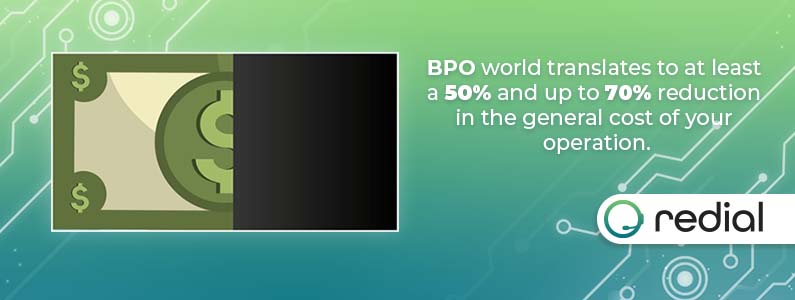
The financial case still matters. Businesses that move call center operations to the right BPO partner typically see cost reductions in the 50 to 70 percent range compared to running the same function in-house, once infrastructure, payroll, and overhead are counted. A cost center becomes a revenue center once the right partner owns it, freeing internal teams to focus on growth instead of staffing.
The Seven Things to Know Before You Sign Any BPO Contract
Every outsourcing decision eventually comes down to the same seven questions. Working through them in order avoids the most common mistakes companies make when moving call center operations to a partner.
Know Which Functions Should Move to Your BPO Partner First
Not every function belongs with a partner on day one. Start by evaluating which parts of the operation, inbound or outbound, can move without disrupting the customer relationship. A smaller portion handled well by the BPO partner builds trust before a larger transition follows, and the omnichannel solutions covered above are usually the second phase, not the first.
The Real Cost Savings You Should Realistically Expect
The savings from outsourcing come from removing fixed costs, infrastructure, HR payroll, benefits, and taxes, not from cutting corners on service quality. Before comparing outsourcing to an in-house build, it helps to know the real cost of replacing an in-house hire, since that cost lands on your budget the moment turnover hits.
Who Benefits Most From Outsourcing Right Now Today?
Startups and small to medium businesses often benefit the most, since outsourcing removes a strain that would otherwise fall on a small internal team right before rapid growth begins. Larger companies use outsourcing differently, to control cost at scale once volume outpaces what an internal team can absorb efficiently.
How Channel Coverage Changes With a BPO Partner Team
A BPO partner typically extends support across more channels than most internal teams can staff alone:
- Phone support during and beyond standard business hours
- Live chat services for real-time, lower-friction resolution
- Email request handling for lower-urgency inquiries
- Omnichannel coordination so a customer’s history follows them across channels
The Real Return on Investment Timeline to Expect Here
Smaller businesses sometimes treat outsourcing as a pure expense line before the return becomes visible. In practice, the return of investment becomes substantial once the right customer experience reaches a growing, loyal client base, typically within the first two to three months as agents ramp up and channel coverage stabilizes.
Cultural and language barriers, when present, put customers on edge during moments that already carry some risk, like a purchase decision or a billing dispute. Cultural and language fit is not a soft factor, it changes resolution speed and retention. This is exactly the gap nearshore call center services are built to close, since agents share time zones, business norms, and often direct cultural familiarity with the customer base being served. Multilingual agents extend this further, giving larger customer segments support in their own language rather than a translated approximation of it.
Choosing a partner with real experience in your industry and time zone avoids the two most common failure points: an offshore partner that cannot match your business hours, and a generalist partner without depth in your specific vertical. For a deeper walkthrough, how to choose the right outsourcing partner in Mexico covers the full evaluation process, and the questions worth asking a nearshore provider is a useful companion checklist before any contract is signed.
Outsourcing Call Center Services: In-House vs BPO Costs Now
The decision to keep call center operations in-house or move to a BPO partner comes down to a small set of factors that compound over time. Outsourcing call center services tends to win on cost, scalability, and channel coverage, while in-house retains the edge only when volume is small, predictable, and unlikely to need multilingual or omnichannel support anytime soon.
| Factor | In-house call center | Outsourced BPO partner |
| Setup and hiring time | 8 to 12 weeks typical | 2 to 4 weeks with a vetted partner |
| Cost structure | Fixed: salaries, benefits, real estate, tech | Variable: per-seat or per-transaction |
| Typical cost reduction | Baseline, no reduction | 50 to 70 percent of operating cost, per industry benchmarks |
| Channel coverage | Limited by in-house headcount | Omnichannel (phone, chat, email) built into most BPO stacks |
| Scaling for peak season | Requires new hiring cycle | Managed inside the partner contract |
| Multilingual support | Requires separate hires per language | Often included as a standard capability |
| Turnover risk exposure | Direct, falls on your HR budget | Absorbed by the BPO partner’s bench |
What to Look For in a Call Center Outsourcing Partner Now?
Once the seven questions above are answered, the remaining decision is which partner earns the contract. Look for:
- A large, well-trained talent pool: the partner should be able to staff your program from day one, not build a team from scratch after the contract is signed.
- Modern technology and methodology: outdated tooling shows up quickly in resolution times and customer satisfaction scores.
- Fast, reliable communication channels inside your time zone: a partner offering full BPO services stack should include real-time channels, not delayed handoffs across time zones.
- Deep knowledge of your specific industry: a generalist partner takes longer to reach the fluency a specialist partner starts with.
- A track record with businesses your size: a partner built for enterprise accounts may underserve a growing SMB, and the reverse is also true.
Ready to see what outsourcing could look like for your team?
Redial BPO works with businesses moving call center operations to a nearshore partner built around US time zones, bilingual talent, and industry-specific experience. If you are weighing the seven questions above against your own numbers, we can walk through what a program looks like for your volume and use case.
Contact us to discuss your outsourcing plan, or get a free quote for your specific use case.

Frequently Asked Questions About Outsourcing Call Center Services
1. What should I know before outsourcing call center services?
Know which functions to move first, the real cost savings to expect, who benefits most from outsourcing, how channel coverage changes, the realistic ROI timeline, how cultural fit affects results, and what to ask before choosing a partner. These seven areas cover the decisions that determine whether an outsourcing relationship succeeds.
2. How much does outsourcing call center services typically save?
Most businesses see a reduction of 50 to 70 percent in general operating cost compared to running the same function in-house, once infrastructure, HR payroll, and overhead are factored in. Actual savings depend on function complexity, volume, and the partner’s cost structure.
3. Is outsourcing call center services only for large companies?
No. Startups and small to medium businesses often benefit the most, since outsourcing removes the strain of building a call center team before rapid growth begins. Larger companies use outsourcing to control cost at scale, while smaller ones use it to avoid overextending limited resources.
4. What is the realistic timeline to see ROI from outsourcing?
Most operations see measurable return within the first two to three months, once agents are trained and channel coverage stabilizes. The clearest early signal is usually reduced cost per resolution, followed by improved customer experience scores in the following quarter.
5. Why does cultural fit matter when outsourcing call center services?
Cultural and language alignment directly affects how quickly agents resolve issues and how comfortable customers feel during sensitive interactions. A partner with shared time zones, language fluency, and cultural familiarity reduces escalations and builds trust faster than a partner without that alignment.

Redialers Insights is Redial BPO’s editorial voice, sharing practical perspectives on business performance, operational excellence, customer experience, and company culture.
We share real-world learnings and timely updates to offer prospective clients a clear, trustworthy view of how Redial BPO supports brands, their customers and internal teams.